Choosing a format
Which Pickleball Format Should You Run? Round Robin vs King of the Court vs Pool Play vs Brackets
A decision guide to every way of organizing pickleball — open play rotations, round robins, king of the court, ladders, pool play, single and double elimination — with the one question that picks the right format, quick answers for every player count from 4 to 40, and the trade-offs each choice makes.
Updated 7 min readBy the PicklePal team
On this page
There are only about eight ways to organize pickleball, and every event you have ever played was one of them wearing different clothes. Organizers get into trouble not by picking a "bad" format but by picking one that ends differently than the group wanted — a bracket for a social crowd that came to mix, or a casual rotation for a field that wanted a winner.
This guide is the map. It gives you the one-question decision, a format-by-format comparison of the trade-offs, and a quick answer for every player count from 4 to 40. Each format links to a full setup guide.
The one-question decision
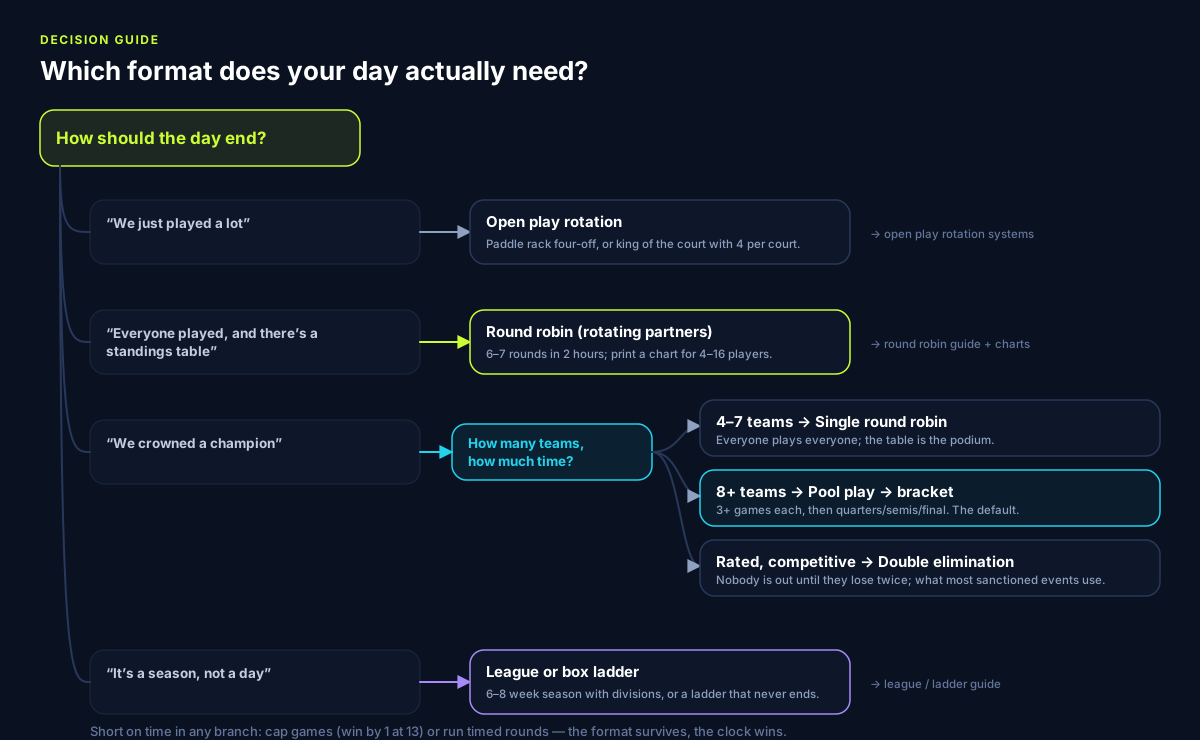
Work down the tree, then use the quick answers below to sanity-check against your player count. If two branches both feel right — a social night and a champion — pool play with rotating partners is the compromise built for exactly that: the session plays like a mixer and still ends with a final.
The eight formats in one table
| Format | Ranks | Games per player | Ends with | Best size | Full guide |
|---|---|---|---|---|---|
| Open play rotation (paddle rack) | Nobody | Varies with the queue | Nothing — that's the point | Any | Open play systems |
| King of the court | Courts, loosely | 5–8 timed rounds | Whoever holds the top court | 8, 12, 16, 20 | Open play systems |
| Round robin, rotating partners | Individuals | 4–7 | A standings table | 4–16 per group | Round robin guide |
| Round robin, fixed partners | Teams | T − 1 games | A standings table | 4–7 teams | Round robin guide |
| Pool play → bracket | Teams or individuals | 3–6 | A champion + full rankings | 8–24 teams or 12–16 players | Pool play guide |
| Single elimination | Teams | 1–4 | A champion, fast | Playoffs only | Tournament guide |
| Double elimination | Teams | 2–9 | A champion, fairly | 8–16 per division | Tournament guide |
| League / ladder | Individuals or teams over weeks | 3–4 per week | A season champion | 8+ per division | League & ladder guide |
The trade-offs that actually separate them
Mixing vs. ranking
Formats sit on a spectrum. Open play maximizes mixing and ranks nobody. A double-elimination bracket ranks precisely and mixes nobody — you play your partner and whoever the draw serves up. The rotating-partner round robin is the only format high on both, which is why it is the default club night: everyone plays with everyone, and there is a table at the end.
If your group argues about whether the night should be competitive, run the round robin and let the table be optional reading.
Guaranteed games vs. a clean story
Elimination brackets tell the best story — win or go home, a final everyone watches — and treat half the field worst, with one game and done. Round robins guarantee everyone the same games and end in a spreadsheet. Pool play into a bracket is the engineered compromise: a three-game floor for everyone, a final for the story. That compromise is why it is the recommended format for almost any event where people paid, travelled or trained. The numbers are worked through in how to run a tournament.
Sorting by results vs. seeding by judgment
King of the court and ladders discover the ranking as they run — winners drift up, and by round four the top court is the best four players in the building. Brackets and pools need the ranking up front, as seeding, and reward you for getting it right. If you cannot seed — no ratings, new group — either run a format that sorts itself, or run pool play, which corrects bad seeding by the time the bracket starts.
One organizer's evening vs. one organizer's month
Open play runs itself off a paddle rack. A round robin needs a rotation and a score sheet. Pool play adds seeding and a bracket. A tournament adds registration, divisions and a schedule. A league adds subs, make-ups and eight consecutive Tuesdays. Pick the most ambitious format you can staff, not the most ambitious format you can imagine — an under-staffed tournament is a worse night than a well-run round robin.
Quick answers by player count
| You have | Best format | Why |
|---|---|---|
| 4 players | 3-round round robin | Everyone partners everyone once; chart here |
| 5–7 players | Round robin with rotating sit-outs | The charts keep sit-outs fair; skinny singles soaks up a spare player |
| 8 players | The perfect 7-round round robin — or king of the court on 2 courts | 8 is the magic number: perfect rotation exists, and 2 courts of 4 sort cleanly |
| 9–11 players | Round robin, 2 courts | One to three sit each round by chart |
| 12 players | Round robin on 3 courts, or two pools of 6 → final | Pool version adds a champion in the same two hours |
| 16 players | Two pools of 8 → semis and final, or king of the court on 4 courts | The 16-player night with a finish |
| 8–24 teams (pairs) | Pool play → single-elimination bracket | Three-game floor, seeded bracket, predictable clock |
| 24–40 players, social | Skill-banded open play or two round robin flights | Above ~16 in one event, split before you schedule |
| Any size, every week | Individual league (weekly round robins) or a box ladder | League for committed regulars; ladder for come-when-you-can |
Match the format to the time slot
Time never forces a different format — it forces shorter games. A game to 11, win by 2, runs 15–25 minutes; capped or timed games are predictable.
- 60 minutes: 3–4 timed rounds of a round robin, or open play. No brackets — there is no time to wait for a final.
- 90 minutes: 5–6 rounds of a round robin; or two pools of 4 (fixed pairs) into a single final if games are capped.
- 2 hours: the full menu — a 7-round perfect round robin for 8, pools + playoff for 12–16, king of the court with 8 timed rounds.
- Half a day: a 16-team pool-play tournament on 4 courts, or a 3-division wave on 6.
- A weekend: multi-division tournament territory; double elimination becomes affordable.
The scoring menu that makes any of this fit — caps, rally scoring, timed rounds — is in tiebreakers and scoring formats.
Three groups, three right answers
Common mistakes
- A bracket for a social crowd. Half of them play once and stand around. If people came to play, guarantee games.
- A round robin for a field that wanted a champion. The night ends with a spreadsheet and a shrug. Add a playoff — even a single final transforms it.
- King of the court with the wrong count. It needs exactly four per court. With 10 or 14 players, run a round robin instead; the charts handle sit-outs.
- Double elimination on a tight clock. The consolation bracket runs long and cannot be rushed. If the venue closes at 5, pool play.
- Choosing by what you ran last time. Formats are cheap to switch. Match the ending to the crowd in front of you, not the crowd you had in March.
Frequently asked questions
What is the best pickleball tournament format?
Pool play into a single-elimination bracket, for almost every club and community event: every team is guaranteed three or more games, the bracket is seeded by pool results instead of guesses, and the schedule is predictable. Double elimination is what most sanctioned events use when time allows; single elimination alone only fits a playoff or a very short slot.
What is the best format for a pickleball social night?
A rotating-partner round robin. Everyone gets a new partner every round, games and sit-outs come out even, and there is a light-stakes standings table at the end. For a pure drop-in with no fixed roster, a paddle-rack open play rotation is simpler.
Round robin or king of the court — which should I run?
Round robin when you want equal games, fair sit-outs and a standings table, and whenever your player count is not a multiple of four. King of the court when you have exactly 8, 12, 16 or 20 players, a timer, and a group that enjoys the drama of moving up and down courts. King of the court sorts players by results; a round robin measures them.
What format works for 12 pickleball players?
On three courts, a rotating-partner round robin (nobody sits; 11 rounds is the perfect rotation, 6–7 rounds is a normal night). On two courts, two pools of 6 with rotating partners and a final between the top finishers adds a champion in the same two hours.
What format should a new group with no ratings use?
One that sorts itself: a rotating-partner round robin (the standings after two weeks are your ratings) or king of the court. Save seeded formats — brackets, snake-seeded pools — for when you have results or DUPR ratings to seed from.
How do I add a winner to a casual night without making it a tournament?
Run the normal round robin, then send the top four into one semi-final round and a final in the last 30 minutes — or use pool play with rotating partners, where the pool stage feels like a mixer and the playoff pairs the pool winners together. Everyone else keeps playing on the other courts.
Keep reading
- Round robinHow to Set Up a Pickleball Round Robin (Formats, Rounds, Courts and Fair Rotations)A step-by-step guide to running a pickleball round robin for 4 to 40+ players — the five round robin formats, how many rounds and courts you need, how to handle sit-outs and odd numbers, which scoring to use, and how to pick a winner without an argument.
- Pool playHow to Set Up Pickleball Pool Play (Pool Sizes, Seeding, Tiebreakers and the Playoff)How to run pickleball pool play that finishes on time — choosing pool sizes, snake-seeding by rating, scheduling the round robin inside each pool, breaking ties the USA Pickleball way, and crossing the top finishers into a playoff bracket. Covers fixed-partner pools and rotating-partner pools with an individual table.
- TournamentHow to Run a Pickleball Tournament (Formats, Divisions, Court Math, Scheduling and a Day-Of Checklist)The organizer's guide to running a pickleball tournament, from an 8-team club championship to a sanctioned multi-division event — picking a format, sizing divisions, doing the court and time math, seeding brackets, setting scoring rules, staffing the day and avoiding the mistakes that put you two hours behind by lunch.
- Open playPickleball Open Play Rotation Systems: Paddle Stacking, King of the Court, Challenge Courts and MoreEvery way to rotate players through courts at pickleball open play — four-off paddle racks, two-off winners-stay, king of the court, skill-banded racks, numbered rotations, scheduled round robins and app queues — with how each works, the wait-time math, which one fits your group size and skill spread, and the house rules that stop the arguments.