Groups & community
How to Start a Pickleball Group (and Keep People Coming Back)
A practical playbook for starting a pickleball group from scratch — finding courts and your first 8 players, picking a weekly format, handling skill levels and no-shows, choosing one communication channel, and the engagement habits that turn a pickup session into a community that runs itself.
Updated 10 min readBy the PicklePal team
On this page
- Decide what the group is for
- Find a court and a time
- Find your first players
- Pick a format that runs itself
- Keep score, and post it
- Set up one channel and one way to RSVP
- Deal with skill levels before they become a problem
- The engagement playbook
- Money
- Handle the problems every group gets
- When to grow, split or become a club
- A first-month plan
- Frequently asked questions
Every pickleball group starts the same way: three or four people who want to play more often than their local open play allows. The ones that are still going two years later did a handful of things differently in the first two months.
This guide is those things — what to decide before the first session, how to keep a mixed-skill group happy, and the small habits that keep people coming back. It is written for a volunteer organizer with a group chat and a phone, not a club with a budget.
Decide what the group is for
One sentence, before anything else: who is this for, and what does a good night look like?
| Kind of group | Good night looks like | Format that fits | Size that works |
|---|---|---|---|
| Social / drop-in | Lots of games, new faces, no pressure | Open play rotation or a casual round robin | 8–16 per session |
| Skill-specific (e.g. 3.5+) | Close, competitive games | Rating-balanced round robin; ladder | 8–12 per session |
| Beginner-friendly | Nobody feels lost | Short clinic + round robin with timed games | 6–12 per session |
| Competitive / league | A table to climb, a season, a final | League or ladder with a playoff | 12–24 across divisions |
| Community club | All of the above across the week | Scheduled sessions by level | 40+ members |
You do not have to pick one forever. Most groups start social and add a competitive night later. But the first sessions need a clear promise, because "everyone welcome" with no structure is how a 3.0 ends up on court with two 4.5s and never comes back.
Find a court and a time
Courts. Public parks are the default and often free; check whether the city takes reservations or permits for groups, because a reserved court is the difference between "we play Tuesdays at 6" and "we hope to." Community centres, YMCAs and schools rent indoor courts by the hour. Tennis courts with portable nets and temporary lines work for a weekly group that owns two nets.
Time. Pick one slot and never move it. Weekday evenings and weekend mornings fill fastest. Ninety minutes to two hours is the sweet spot: long enough for 5–7 games, short enough that people with families can commit.
Court-to-player ratio. A doubles court holds four. Aim for at most one sitting player per court per round: 8–10 players on two courts, 12–15 on three. More than that and people spend the evening watching.
Find your first players
You need 6 to 12 regulars to start, and about two to three times your court capacity on the roster, because on any given week a third to a half of them will not come.
- Start with people you have already played with. Open play regulars, the two couples from the clinic, a coworker who mentioned pickleball.
- Ask each of them to bring one person. A group of 6 becomes 12 in a week.
- Post once where local players already look: the city's pickleball Facebook group, the rec centre notice board, a local pickleball app or directory. Say the day, time, venue, level and how to RSVP.
- Run a beginner night once a month if you want growth. It is the single best recruiting tool, because beginners bring friends.
Skip the flyer campaign. A group that runs well on Tuesdays grows by word of mouth faster than any poster.
Pick a format that runs itself
The organizer cannot spend the evening matching people up. The format has to do it.
For a new group, a rotating-partner round robin is hard to beat: everyone gets a new partner every game, everyone plays the same number of games, sit-outs rotate fairly, and there is a standing at the end. Newcomers meet the whole group in one night, which is the point. How to set up a round robin has the rounds-and-courts math; the short version is 6–7 rounds in two hours.
Once the group is established, vary the format so the regulars do not get bored:
- King of the court on nights with exactly 8, 12, 16 or 20 players — see open play rotation systems.
- Pool play with a playoff once a month for a night with a winner — see how to set up pool play.
- A ladder or short league for the competitive core — see how to run a league or ladder.
- A club championship once or twice a year — see how to run a tournament.
Keep score, and post it
In our experience the groups that keep score are the ones still going a year later. Not because people are competitive — many are not — but because a result gives the evening a shape: a standing to check, a photo of the top three, something to talk about in the chat.
- Keep it light: wins, then point differential. No ratings required.
- Post the standings and a photo within an hour of finishing. Tag people.
- Keep a season table if the group likes it — a running tally across the month with a "player of the month."
- Never let the standings decide who gets to play. Court time is for everyone; the table is for fun.
Set up one channel and one way to RSVP
The biggest organizational mistake is communication spread across three places. Pick one chat (WhatsApp, GroupMe, a Facebook group — whatever the majority already uses) and one RSVP method, and use them for everything.
The RSVP method can be a pinned poll, a sign-up sheet, a scheduling app, or a simple "thumbs up by Monday night." What matters:
- A cut-off time — "RSVP by 6 pm the day before" — so you know the numbers and can build the rotation.
- A cap and a waitlist. Ten spots for two courts; the eleventh goes on the waitlist and is promoted the moment someone drops.
- The rules pinned where people sign up: format, scoring, start time, what it costs, what to bring.
Deal with skill levels before they become a problem
The most common reason people quietly stop coming is mismatched games. Strong players find it boring; newer players find it humiliating. Neither says so — they just stop RSVPing.
Three approaches, from simplest to most structured:
- Balance the courts. If you run a round robin, put the strongest and weakest player on a court together against two middle players. With ratings (DUPR or your own 1–5 scale) an app can do this for you; without, the organizer does it by eye for the first round and lets the rotation handle the rest.
- Band the sessions. Once you have 16+ regulars, split into two sessions or two flights by level: a 2.5–3.25 group and a 3.5+ group. Use results, not self-ratings; people over-rate themselves.
- Run a beginner on-ramp. A 30-minute clinic before the session, run by a patient regular, followed by timed games with the group. Beginners who feel welcome become your most loyal members.
What not to do: let self-sorting happen. Without a rotation, the strong players find each other, the courts stratify, and the new players end up on the worst court with no way off it. A rotation — any rotation — prevents that.
The engagement playbook
Engagement is not an event; it is a routine. These take about fifteen minutes a week between them.
| Habit | When | Why it works |
|---|---|---|
| Greet everyone by name; introduce newcomers to two regulars | First 5 minutes | A newcomer who knows two names comes back |
| Start on time, every time | 6:00 means 6:00 | People commit to things that respect their time |
| Post results and a photo | Within the hour | Closes the loop; gives the chat something to react to |
| Message every newcomer personally after their first night | Same evening | "Great to have you — same time next week?" makes a second visit far more likely |
| Notice who has not been for 3–4 weeks and check in | Monthly | Most drop-offs are life, not the group; a message brings them back |
| Ask what to change | Every couple of months | A quick poll surfaces the skill-level grumbles before they become exits |
| Hand out roles | As soon as you can | Court captain, ball buyer, photographer, sub-finder — ownership keeps people |
| Do something off-court | Quarterly | Drinks after, a potluck, a group entry in a local tournament |
Recognize people
A "player of the month," a most-improved shout-out, a badge for someone who has brought three new players — none of it costs anything and all of it matters more than people admit. Keep it light and spread it around; the same person winning every month is demotivating for everyone else.
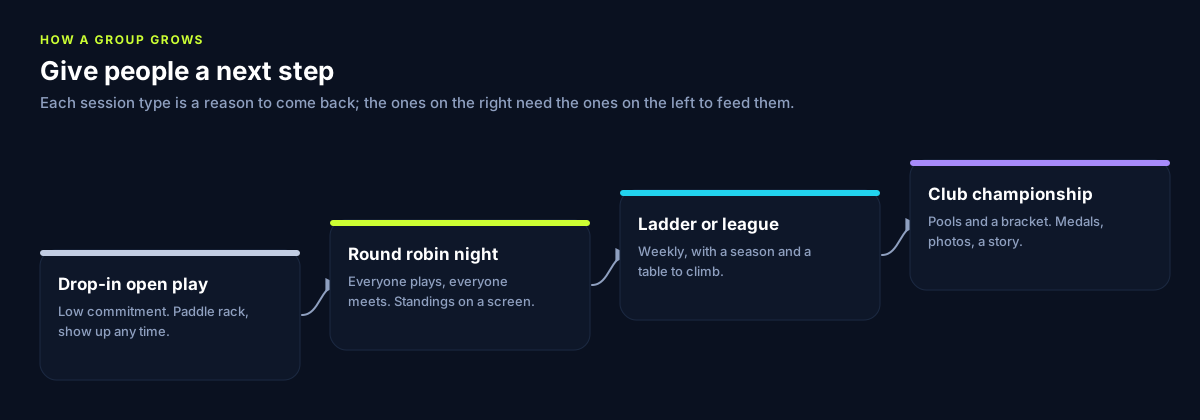
Give people a next step
The regulars who have been coming for six months want something more than another Tuesday. Offer it: a ladder, a short league season, a team entry in a local tournament, a club championship with medals. The ones who want it will step up; the ones who do not still have Tuesday.
Money
Keep it small and transparent. Balls and court fees are the real costs: $3–5 per session or a modest season fee covers two courts and a sleeve of balls, with the remainder going to a banner or a set of end-of-season prizes. Say exactly what the money pays for, and use a shared payment app so nobody is chasing cash.
Free is also fine when courts are free. But a small fee reduces no-shows — people show up for what they have paid for.
Handle the problems every group gets
No-shows. The RSVP cut-off and a waitlist fix most of it. For repeat offenders, a quiet word: "If you RSVP and do not come, someone on the waitlist lost a spot." Some groups drop repeat no-shows to the waitlist for a week. Consistency matters more than the specific rule.
Late arrivals. Start the first round on time with whoever is there. Late players join from the next round with priority for court time.
The court hog. The player who only wants to play with the best three. The rotation handles it; if they resist the rotation, the format is not optional.
The sandbagger. A strong player who stays in the beginner session. Move them up, kindly and privately, with results as the reason.
Disputes. Players call their own lines; a replay on any honest disagreement; the organizer's decision is final and not debated on court. Put it in the pinned rules.
Organizer burnout. The group will outlast your enthusiasm only if you share the load early. A co-organizer who can run a night without you is not a luxury; it is the difference between a group and a hobby.
When to grow, split or become a club
- Waitlist every week for a month: add a second session (a different day, or a different level) rather than squeezing more people onto the same courts.
- Two clearly different skill groups: split by level. Two happy sessions beat one frustrated one.
- 40+ regular members, fees and reserved courts: you are a club. Formalize it — a simple membership, a bank account, liability insurance through a national or regional pickleball body, a code of conduct. That is the point at which a written structure protects the organizers as much as the members.
A first-month plan
| Week | Do this |
|---|---|
| 1 | Book a court slot (two courts for 8 people). Invite 8 people you know. Run a 6-round round robin. Post the results. |
| 2 | Ask everyone to bring one person. Pin the rules and the RSVP post. Cap at 10. |
| 3 | First newcomers arrive. Greet, introduce, rotate. Message each one afterwards. |
| 4 | Poll: day/time/format working? Add a waitlist. Recruit a co-organizer. |
| 5–8 | Vary the format once. Start a monthly table. Plan the first beginner night or the first pool-play night. |
Frequently asked questions
How many players do you need to start a pickleball group?
Six to eight regulars and one court is enough to start. Aim for a roster of two to three times your court capacity — 16 to 24 names for two courts — because a third to a half of them will miss any given week.
How do I find players for a pickleball group?
Start with people you have already played with and ask each to bring one person. Post once in the local pickleball Facebook group or directory with the day, time, venue, level and how to RSVP. A monthly beginner night brings in new players faster than anything else.
What is the best format for a weekly pickleball group?
A rotating-partner round robin: everyone plays with everyone, games and sit-outs come out even, newcomers meet the group in one night and there is a standing at the end. Vary it with king of the court (8, 12, 16 or 20 players) or a pool-play night once the group is established.
How do you handle different skill levels in a pickleball group?
Balance the courts (strongest with weakest against two middle players), split into skill bands once you have 16 or more regulars, and run a beginner on-ramp. Always use a rotation so the courts cannot stratify on their own.
How do you stop no-shows?
An RSVP cut-off the day before, a cap with a waitlist, and a small per-session fee. Apply the same rule to everyone; consistency matters more than strictness.
Should a pickleball group charge money?
A small fee — a few dollars a session or a modest season fee — covers balls and court bookings and reduces no-shows. Publish what it pays for and collect it through a shared payment app. Free works when courts are free.
How do you keep a pickleball group engaged?
Same time every week, start on time, greet people by name, post results and photos, message newcomers after their first night, check in on anyone who has missed a month, ask for feedback, hand out roles, and give the regulars a next step — a ladder, a league or a club championship.
Keep reading
- Round robinHow to Set Up a Pickleball Round Robin (Formats, Rounds, Courts and Fair Rotations)A step-by-step guide to running a pickleball round robin for 4 to 40+ players — the five round robin formats, how many rounds and courts you need, how to handle sit-outs and odd numbers, which scoring to use, and how to pick a winner without an argument.
- Open playPickleball Open Play Rotation Systems: Paddle Stacking, King of the Court, Challenge Courts and MoreEvery way to rotate players through courts at pickleball open play — four-off paddle racks, two-off winners-stay, king of the court, skill-banded racks, numbered rotations, scheduled round robins and app queues — with how each works, the wait-time math, which one fits your group size and skill spread, and the house rules that stop the arguments.
- EtiquettePickleball Etiquette: The Written Version of the Unwritten RulesThe unwritten rules of pickleball, written down — line calls and honest doubt, "ball on!" and court safety, crossing behind live courts, open play and paddle rack manners, partner and opponent etiquette, and what an organizer should actually enforce, with a code of conduct you can copy for your group.
- Leagues & laddersHow to Run a Pickleball League or Ladder (Season Structure, Divisions, Subs, Standings and Playoffs)How to set up a pickleball league or ladder that people re-register for — choosing between a team league, an individual round-robin league, a box ladder and a flex league; season length and divisions by rating; the court and time math; subs, no-shows and forfeits; weekly standings; and a playoff night that ends the season properly.