Round robin
How to Set Up a Pickleball Round Robin (Formats, Rounds, Courts and Fair Rotations)
A step-by-step guide to running a pickleball round robin for 4 to 40+ players — the five round robin formats, how many rounds and courts you need, how to handle sit-outs and odd numbers, which scoring to use, and how to pick a winner without an argument.
Updated 15 min readBy the PicklePal team
On this page
- What a pickleball round robin is (and what it is not)
- The five round robin formats
- Step 1: Count players and courts, then do the math
- Step 2: Choose the scoring rules before anyone picks up a paddle
- Step 3: Build the rotation
- Step 4: Handle the numbers that never come out even
- Step 5: Run the night
- Worked examples
- Common mistakes
- Frequently asked questions
A round robin is the format almost every pickleball group ends up running. It fixes the two things that wreck a pickup night: people standing around, and the same four players hogging a court.
Done right, everyone plays about the same amount, with a mix of partners and opponents, and there is a real standing at the end. Done wrong, someone sits out three rounds in a row, two friends partner every game, and you spend the evening with a clipboard instead of a paddle.
This is the guide we wish we had when we started running Tuesday nights.
What a pickleball round robin is (and what it is not)
In most sports, "round robin" means every team plays every other team once. Pickleball borrowed the term and stretched it. When a club says "round robin" it usually means one of two things:
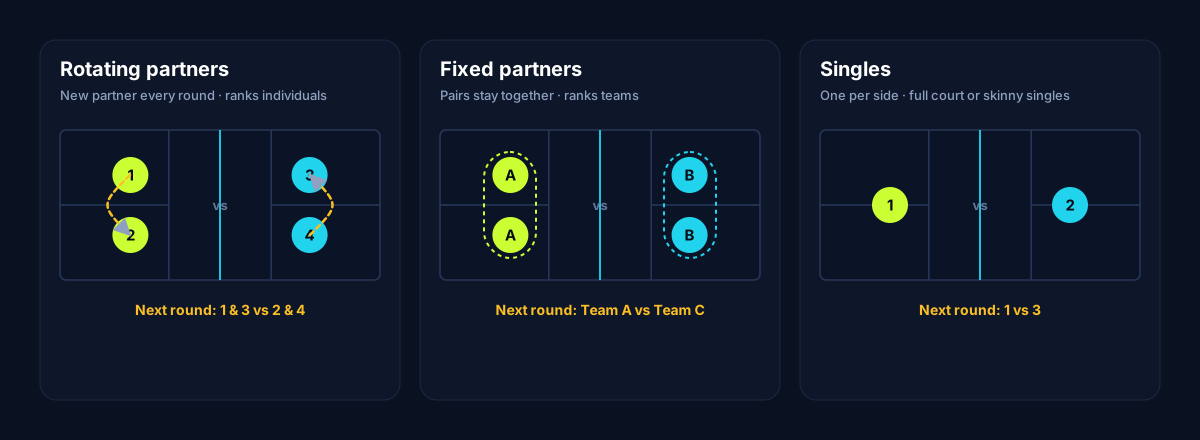
- A rotating-partner round robin — also called a mixer, scramble or social round robin. You get a new partner every round and are ranked as an individual. This is the most common format for open play and club nights.
- A fixed-partner round robin, where pairs stay together and every team plays every other team. This is the classic round robin and the backbone of tournament pool play.
What it is not is a ladder or king-of-the-court format, where winners move up a court and losers move down. Those rank by momentum rather than by a complete schedule. If that is what you want, read open play rotation systems instead.
The five round robin formats
Most decisions flow from one question: how do you want the night to end? If the answer is "everyone played a lot and met everyone," you want rotating partners. If the answer is "we crowned a winning team," you want fixed partners.
| Format | Who is ranked | Best for | Watch out for |
|---|---|---|---|
| Rotating partners (mixer) | Individuals | Open play, club nights, social leagues | Strong players carry weak partners unless you balance by rating |
| Fixed partners | Teams | Competitive nights, pre-formed pairs, pool stages | Long schedules above 8 teams — split into pools |
| Singles | Individuals | Small groups, ladders, skinny-singles drills | Longer, more tiring games |
| Skill-banded flights | Individuals or teams within each band | Mixed-level groups of 12+ | Self-rated levels are unreliable |
| Rating-balanced mixer | Individuals | Mixed-level groups that want close games | Needs ratings for most of the field |
Rotating partners (the social mixer)
Each round, the schedule gives every player a new partner and two new opponents. You record the score of each game, and every player gets credit for the result of the game they were in. After 6–8 rounds, the player with the most wins — then the best point differential — is the winner.
Why it works: nobody is stuck with one partner, beginners get to play with strong players, and the individual standings give every game a stake without anyone needing to bring a partner.
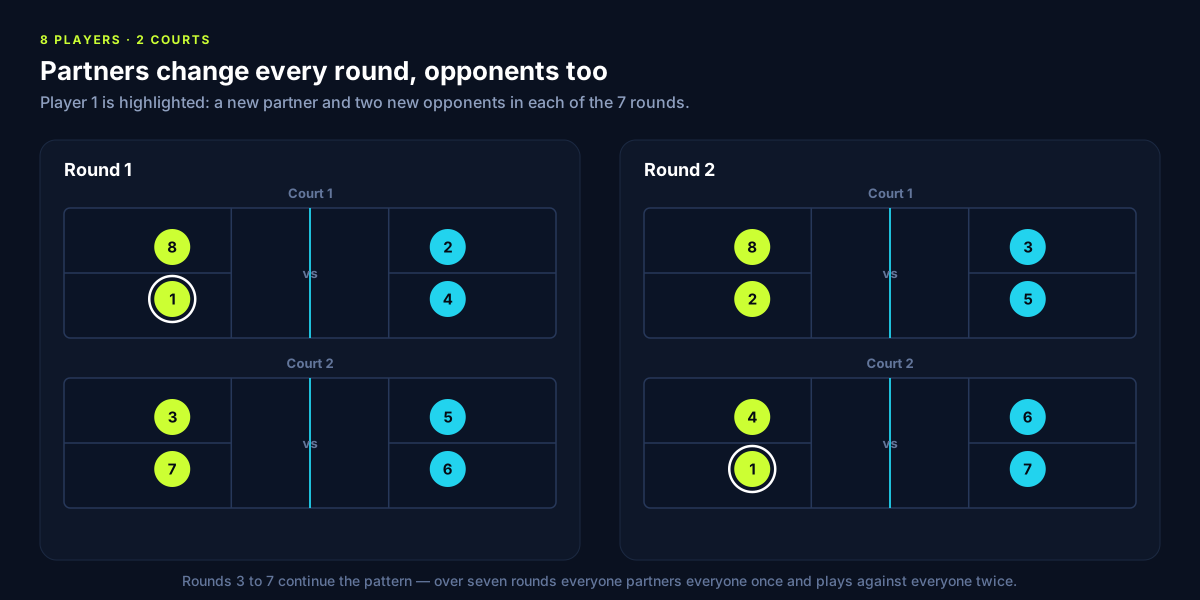
The quality of a mixer lives in the rotation. A good schedule:
- keeps games played within one of each other,
- never sits the same person out twice in a row,
- avoids repeating partners until everyone has partnered everyone, and
- spreads opponents around too.
For 8, 12 or 16 players a perfect rotation exists on paper — everyone partners everyone exactly once and opposes everyone exactly twice. You can print one from our round robin charts for 4 to 16 players.
Fixed partners
Teams are locked. With T teams, each team plays T − 1 games, and the event has T × (T − 1) ÷ 2 games in total. Six teams means 15 games; eight teams means 28.
Use this when people sign up as pairs, when you want a result that reflects a partnership, or as the pool stage before a playoff. It is the format for a fundraiser or a one-day club tournament where "we won" matters more than "I met new people." Rank teams by wins, then head-to-head, then point differential — the first steps of the USA Pickleball order (rule 15.B.4).
Singles
The same schedule as fixed partners, with one player per side. Singles games take longer and are more tiring, so most groups run fewer rounds, cap games at 11 with a hard stop, or play skinny singles on half the court — the version USA Pickleball codifies as mini-singles.
Skill-banded flights
When a 24-player group spans 2.5 to 4.5, one big mixer produces blowouts. Split the field into flights of 8 or 12 by rating or by last month's results, and run a separate round robin in each.
Each flight needs its own courts (8 players = 2 courts, 12 players = 3), so this only works when you have the space. If you would rather keep everyone in one event and still get a clean finish, pool play with a crossover playoff solves the same problem — see how to set up pool play.
Rating-balanced mixer
A hybrid that keeps the social format but uses DUPR ratings to build each court. The strongest player on a court pairs with the weakest, and the combined ratings on each side stay close. Everyone still rotates; the games just land closer.
In our testing on a 16-player field rated 2.8 to 4.6 (seven rounds on four courts, averaged over 20 random draws), balancing cut the average gap between the two sides of a court from 0.84 rating points to 0.14. Games within half a rating point of even went from 10 of 28 to 27 of 28 — with no change to games played and no added partner repeats.
Step 1: Count players and courts, then do the math
Everything depends on three numbers: players, courts and the time you have. A doubles court holds four players per game, so each round puts 4 × courts players on court and the rest sit.
| Players | Courts | Playing per round | Sitting per round | Games come out equal after… |
|---|---|---|---|---|
| 4 | 1 | 4 | 0 | every round |
| 5 | 1 | 4 | 1 | 5 rounds |
| 6 | 1 | 4 | 2 | 3 rounds |
| 7 | 1 | 4 | 3 | 7 rounds |
| 8 | 2 | 8 | 0 | every round |
| 9 | 2 | 8 | 1 | 9 rounds |
| 10 | 2 | 8 | 2 | 5 rounds |
| 11 | 2 | 8 | 3 | 11 rounds |
| 12 | 3 | 12 | 0 | every round |
| 13 | 3 | 12 | 1 | 13 rounds |
| 14 | 3 | 12 | 2 | 7 rounds |
| 15 | 3 | 12 | 3 | 5 rounds |
| 16 | 4 | 16 | 0 | every round |
Two things jump out. Multiples of four with a court for every four players are the easy cases: nobody ever sits. And groups one short of a multiple of four (7, 11, 15) are the hard cases: three people sit every round, and for 7 or 11 players it takes a full cycle (7 or 11 rounds) before everyone has sat the same number of times.
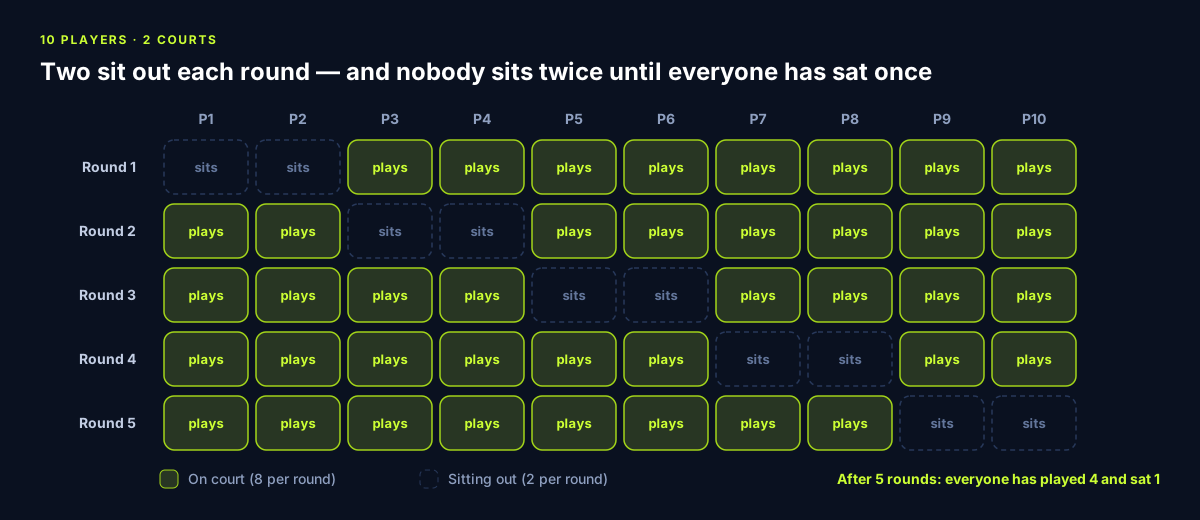
If you have more players than your courts can hold — 16 players on 2 courts, say — a round robin still works, but half the field sits each round. Fine for a drop-in; miserable for a league. The rule of thumb: at most one sitting player per court per round. Ten players on 2 courts works. Sixteen on 2 means people go home.
How many rounds?
For a rotating-partner mixer, the number of rounds until everyone has partnered everyone once is:
Rounds for a full rotation = players × (players − 1) ÷ (4 × courts)
- 8 players, 2 courts: 8 × 7 ÷ 8 = 7 rounds
- 12 players, 3 courts: 12 × 11 ÷ 12 = 11 rounds
- 16 players, 4 courts: 16 × 15 ÷ 16 = 15 rounds
- 10 players, 2 courts: 10 × 9 ÷ 8 = 11.25 → 12 rounds to partner everyone, but 5 or 10 rounds to keep games equal
You rarely need the full rotation. A 2-hour slot with games to 11 fits 6 to 7 rounds, and most players are happy to have partnered most of the field. Decide the round count from your time slot first, then let the schedule spread partners as evenly as it can.
For fixed partners with T teams: T − 1 rounds when T is even, T rounds when T is odd (one team sits each round), provided you have at least T ÷ 2 courts. With fewer courts, multiply: 6 teams on 2 courts need 15 games ÷ 2 courts = 8 time slots at best, and 10 if you keep each circle-method round together.
How long will it take?
A recreational doubles game to 11, win by 2, usually runs 15 to 25 minutes for rec doubles — quicker at the beginner end, longer once rallies get good. Add a couple of minutes to read the next round, walk to the court and warm up. Budget 18 to 22 minutes per round and you will rarely run late.
| Time slot | Rounds (games to 11) | Rounds (timed at 12 min) |
|---|---|---|
| 60 minutes | 3 | 4 |
| 90 minutes | 5 | 6 |
| 2 hours | 6–7 | 8 |
| 3 hours | 9–10 | 12 |
Long games are the most common reason a round robin falls apart: one court stuck at 10–10 while three courts wait. Two fixes — pick one:
- Cap the game. First to 11, win by 1 at 15; or a hard cap at 13.
- Timed rounds. Everybody starts together, a timer goes off at 12 minutes, the point in progress is finished, and the team ahead wins. Decide in advance whether a tie at the horn counts as half a win each or goes to one deciding rally.
Step 2: Choose the scoring rules before anyone picks up a paddle
Write the rules on the sign-up post. Players argue about scoring only when it was never announced.
- Games to 11, win by 2 — the standard. Fine for 1–2 courts; cap it once you run 3 or more.
- Games to 11, hard cap at 13 (or 15) — keeps the familiar feel and guarantees an end.
- Rally scoring to 15 or 21 — every rally scores, so game length is predictable and newer players find the count easier. USA Pickleball has carried rally scoring as a provisional tournament option since 2025 (and removed its "freeze" for 2026), so it is no longer "house rules."
- Timed rounds — simplest with many courts; keeps the whole event in sync.
For standings, rank by wins first. For fixed teams, break ties the USA Pickleball way (rule 15.B.4): head-to-head, then point differential, then head-to-head differential, then differential against the next-highest team, then points scored. For a rotating-partner mixer, where two players may have met both as partners and as opponents, most organizers skip head-to-head and go wins → point differential → points scored. Point differential rewards close losses over blowouts: a player who lost one game 9–11 finishes above someone who lost 2–11. Worked examples, including three-way ties, are in pickleball tiebreakers and scoring formats.
Step 3: Build the rotation
Three options, in increasing order of effort saved.
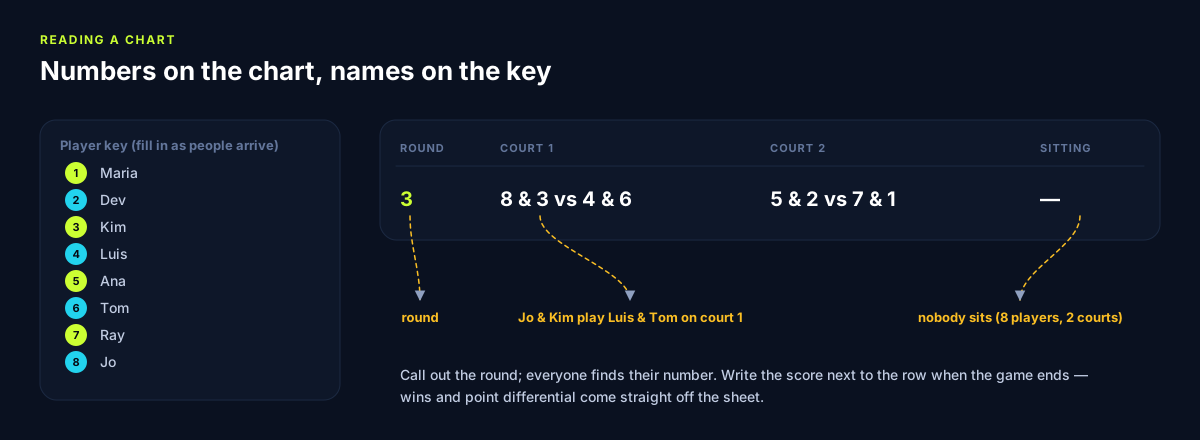
A printed chart. For 4 to 16 players the best possible rotations are known and fit on one sheet. Assign each player a number as they arrive, pin the chart to the fence, and call out "Round 3" when the timer goes. Our printable round robin charts guarantee equal games, no back-to-back sit-outs and the fewest possible repeat partners.
A spreadsheet. Fine for fixed teams, where the circle method (team 1 stays put, everyone else rotates one seat) produces a valid schedule in a minute. Painful for rotating partners with sit-outs, because every late arrival means rebuilding the sheet by hand.
A generator. Type in names and courts, get the schedule, tap scores, and the standings do themselves. The real advantage is not the first schedule — a chart does that — it is what happens at 7:40 when two players leave and one arrives: a generator builds a fresh, fair rotation for whoever is actually there in a second, instead of you redrawing a sheet. One caveat that applies to PicklePal and most other tools: rebuilding replaces the whole schedule, so scores already entered are cleared. Rebuild between rounds, and export or photograph the standings first.
Step 4: Handle the numbers that never come out even
Odd numbers of players
With 5, 9 or 13 players, one person sits each round and the rotation is still perfectly fair over 5, 9 or 13 rounds. With 7, 11 or 15 players, three sit each round, which is a lot. Your options, roughly in order of preference:
- Recruit one more. Post "we need 1" to the group chat before you start. One player turns 7 into 8 and 3 sit-outs into none.
- Split the courts. 7 players can play doubles on one court with 3 sitting, or doubles on one court and skinny singles on the other (4 + 2 playing, 1 sitting).
- Shorten the rounds — timed at 10 minutes — so sitting out costs less.
- Make sitting useful. The sitting players keep score, run the timer or call lines.
Late arrivals and early departures
Decide the rule in advance and apply it without discussion:
- A player arriving after round 1 joins from the next round with zero games played, and the schedule gives them priority for court time until they catch up.
- A player leaving early is removed from the remaining rounds. Their completed games stand.
- If games played differ, rank by win percentage — or rank only players who completed at least two-thirds of the rounds.
More than 16 players
Above 16, run flights. Two groups of 12 on 3 courts each is easier to run, produces closer games, and finishes with two standings tables instead of one enormous one.
If you only have 4 courts for 24 players, a single rotation with 8 sitting each round technically works, but a 2-hour slot then yields only 4 games per person. If you can get six courts, run two flights of 12 on three courts each; if not, accept the 4 games, or split into two 1-hour sessions of 12 for closer games and no sitting.
Step 5: Run the night
The organizer's job on the night is to keep rounds turning over.
- Post the rotation where people stand, not on your phone — a printout on the fence, a whiteboard, or a tablet on the bench. If you use a generator, share the live link so players check their next court themselves.
- Label the courts. Use the numbers painted on the courts and make the schedule use the same numbers.
- Start every round together — a whistle, a timer or a shout. Staggered starts are how one court falls two rounds behind.
- Collect scores on the spot. The winning team calls the score to whoever holds the sheet before leaving the court.
- Announce the standings at halfway. It changes how people play the second half.
- Finish with a result: top three announced, a photo, and the next date.
Worked examples
Common mistakes
- Too many rounds. Schedule for the time you have and cut the rotation short rather than running late.
- Unannounced sit-outs. Players accept sitting when they can see it coming. Show the whole rotation, not just the current round.
- No timer. A round robin without a clock is a queue.
- Mixing 2.5s and 4.5s on random courts. Balance by rating or split into flights.
- Scoring by total points instead of wins. It rewards blowouts and punishes close games.
- Changing rules mid-session. Whatever you announced, stick with it. Fix it next week.
Frequently asked questions
How many players do you need for a pickleball round robin?
Four is the minimum: three rounds where each player partners each of the others once. Five to eight on one or two courts is the sweet spot for a social mixer; twelve on three courts is the ideal league size because nobody sits out.
How long does an 8-player round robin take?
Seven rounds of games to 11 take about 1 hour 45 minutes to 2 hours 20 minutes on two courts, depending on how long your games run. With only 90 minutes, play 5 rounds — everyone still plays 5 games, and the rotation stays fair.
How do you run a round robin with an odd number of players?
One player sits each round and the sit-out rotates so everyone sits the same number of times. With 5, 9 or 13 players it takes exactly 5, 9 or 13 rounds for the sit-outs to come out even. With 7, 11 or 15 players three people sit each round, so try to find one more player, run short timed rounds, or put the spare players on skinny singles.
Should partners rotate or stay fixed?
Rotate partners for social play, open play and any event where you want people to meet each other. Keep partners fixed when pairs have signed up together, when you are running a league season with standings, or when it is the pool stage of a tournament.
Can you run a round robin on one court?
Yes. Four players need no sit-outs; five or six players sit one or two per round. Eight players on one court works for a drop-in but half the group sits every game, so keep rounds short (timed at 10 minutes) or play games to 7.
What is the best scoring for a round robin?
Games to 11 win by 2 for one or two courts; add a hard cap at 13 or 15 once you run three or more courts so a single long game cannot hold up the rest. Timed rounds of 12 minutes are the easiest to manage for big groups. Rank by wins, then point differential.
How do you pick a winner in a round robin?
Most wins. For teams, then head-to-head, then point differential (points scored minus points allowed across all games). For individuals in a mixer, then point differential, then most points scored. A one-game playoff or a skinny singles play-off settles a tie for first if you want it decided on court.
Do you need an app to run a round robin?
No — a printed chart and a pen work for a fixed group of 4 to 16. An app earns its keep when the roster changes during the session, when you have more than 12 players, or when you want live standings on everyone's phone instead of a sheet on the fence.
Keep reading
- ChartsPickleball Round Robin Charts for 4 to 16 Players (Printable Rotation Schedules)Ready-to-print pickleball round robin rotation charts for 4, 5, 6, 7, 8, 9, 10, 11, 12, 13, 14, 15 and 16 players on 1 to 4 courts. Every chart gives everyone the same number of games, rotates sit-outs fairly and keeps partner repeats to the minimum — with the exact fairness stats for each one.
- PrintablesFree Pickleball Printables: Score Sheets, Pool Sheets, Brackets, Sign-In Sheet and Rotation PosterNine free, print-ready PDFs for pickleball organizers — a round robin score sheet, pool play sheets for pools of 4 and 5, single-elimination brackets for 4, 8 and 16 teams, a player sign-in sheet, an open play rotation poster and a fill-in rules one-pager — plus how to use each one so the paper runs the event for you.
- Open playPickleball Open Play Rotation Systems: Paddle Stacking, King of the Court, Challenge Courts and MoreEvery way to rotate players through courts at pickleball open play — four-off paddle racks, two-off winners-stay, king of the court, skill-banded racks, numbered rotations, scheduled round robins and app queues — with how each works, the wait-time math, which one fits your group size and skill spread, and the house rules that stop the arguments.
- Rules & scoringPickleball Tiebreakers and Scoring Formats Explained (Head-to-Head, Point Differential, Rally Scoring, Caps and Skinny Singles)How to score a pickleball event and settle the standings — side-out vs rally scoring, games to 11, 15 or 21, win-by-2 caps, timed rounds and best-of-three; then the USA Pickleball tiebreaker order (head-to-head, point differential, head-to-head differential) with worked two-way and three-way examples, individual standings for rotating-partner events, and when to use a skinny singles play-off.