Charity events
How to Run a Charity Pickleball Tournament That Actually Raises Money
The fundraiser-specific playbook for a charity pickleball tournament — where the money really comes from (sponsorships beat entries), how to price entries and build sponsor tiers, a format that keeps a mixed-ability field happy, raffle and games ideas with the legal cautions, a realistic budget, and the day-of details that make people come back next year.
Updated 8 min readBy the PicklePal team
On this page
- Where the money actually comes from
- Step 1: Lock the cause and the story
- Step 2: Sell sponsorships before you sell entries
- Step 3: Price entries and open registration
- Step 4: Pick a format that keeps donors smiling
- Step 5: Layer the day-of extras
- Budget and a realistic timeline
- Common mistakes
- Frequently asked questions
A charity tournament is two events sharing a set of courts: a pickleball event that must be worth the entry fee, and a fundraiser that must be worth the cause's time. Organizers who treat it as pickleball-with-a-donation-bucket raise a few hundred dollars. Organizers who sell the fundraiser for weeks and then deliver a great day of pickleball raise ten times that.
This guide is the fundraiser half. Everything about brackets, court math and day-of logistics carries over from how to run a tournament; read that for the mechanics. Here we cover the money, the format changes a charity field needs, and the trust-keeping that makes year two bigger than year one.
Where the money actually comes from
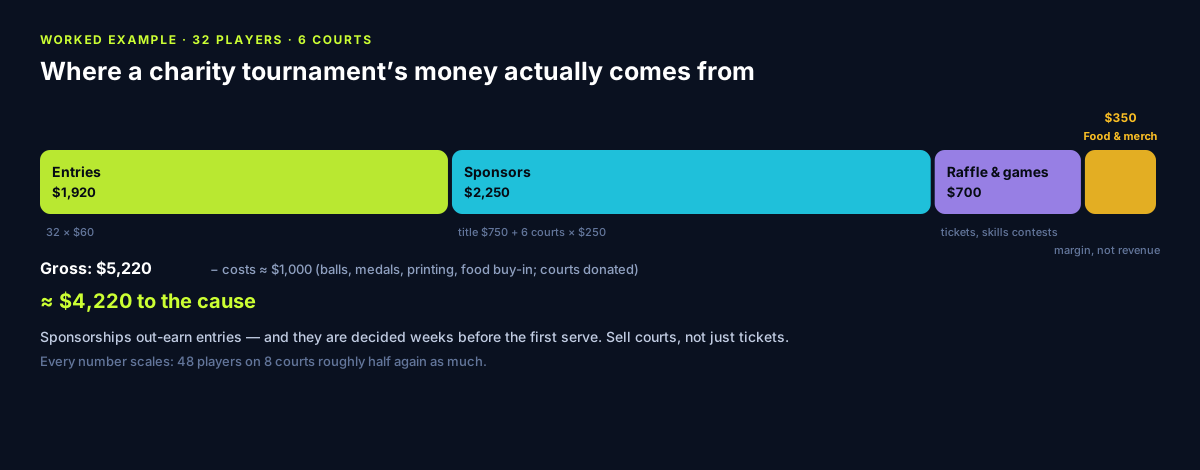
A worked example for a 32-player, 6-court Saturday, and every number in it is one to adjust:
| Stream | Example | Notes |
|---|---|---|
| Entries | 32 players × $60 = $1,920 | The floor of the event; set it first |
| Sponsorships | Title $750 + 6 courts × $250 = $2,250 | Decided 3–6 weeks before the day |
| Raffle & games | ~$700 | Tickets, skills contests, 50/50 where legal |
| Food & merch | ~$350 margin | Often donated outright by a restaurant sponsor |
| Gross | ~$5,220 | |
| Costs | ~−$1,000 | Balls, medals, printing, food buy-in; courts donated |
| To the cause | ~$4,220 | Publish this number |
Three lessons hide in that table. Sponsorships are the biggest line and the least glamorous work. Costs are small if the venue is donated — ask the parks department or a club to sponsor the courts as their contribution. And the raffle and the food margin together roughly pay for the whole cost line, which is a fine way to think about them.
Step 1: Lock the cause and the story
Partner with one named nonprofit and get three things from them in writing: permission to use their name and logo, a sentence on exactly what the money funds ("$4,000 pays for 40 therapy sessions"), and whether they can provide volunteers, a banner and someone to speak for five minutes at the medal ceremony.
Specificity raises money. "Proceeds to charity" is wallpaper; "every court you sponsor funds a week of meals" sells courts. If the nonprofit is a registered charity, ask them how they want donations receipted — and let them own the receipts, the raffle registration and anything else regulated. (None of this page is legal or tax advice; the nonprofit's treasurer has seen it all before.)
Step 2: Sell sponsorships before you sell entries
Sponsors buy visibility and association, and they decide on a timeline of weeks. Start eight weeks out with a one-page menu. An example structure that fits a local event:
| Tier | Example price | What they get |
|---|---|---|
| Title sponsor (1) | $750–2,500 | "The ___ Charity Classic," logo on everything, banner at check-in, a team entry, the thank-you speech slot |
| Court sponsor (one per court) | $100–250 | Court named after them for the day, sign on the fence, name read out with every match called to "the Smith Dental court" |
| In-kind: food, balls, prizes | Goods | Named as the lunch/ball/prize sponsor everywhere those appear |
| Friend of the event | $100 | Name on the banner and the results page |
Court sponsorship is the workhorse: cheap enough for a dentist or a realtor to say yes on the first ask, concrete enough to feel real on the day. Businesses owned by people who play — paddle shops, physio clinics, the coffee place next to the courts — say yes at the highest rate. Make the ask with the flyer in hand and a deadline attached ("logos go to print on the 10th").
Step 3: Price entries and open registration
Real charity events land anywhere from about $40 to $80 a player. $50–75 is comfortable for a half-day event with lunch; $35–45 for something bare-bones; more only when a strong field expects a serious tournament. People pay more per entry for a cause than for a plain tournament — say on the signup page exactly where the margin goes.
Registration mechanics are the same as any tournament — close it a week out, expect a few withdrawals, keep a waitlist — with two charity-specific additions: an "I can't play, donate anyway" button, which quietly collects more than you expect, and an optional fundraise-your-entry mode where players share a pledge link and the top fundraiser gets a prize. Details on divisions, waivers and scheduling: how to run a tournament.
Step 4: Pick a format that keeps donors smiling
A charity field is the widest-skill field you will ever host: club regulars next to the sponsor's cousin who bought a paddle on Thursday. The format has to protect both.
- Pool play, always. Everyone gets three or more games; nobody drives home after one loss. The mechanics are in how to set up pool play.
- Two divisions minimum: competitive and social, self-selected at signup with honest descriptions ("Social: nobody is keeping DUPR; Competitive: they are"). Merge or split on the numbers a week out.
- Rotating partners for the social division works even better: solo signups welcome, everyone meets people, and the playoff pairs pool winners together.
- Cap the games (to 11, hard cap 13, or timed) so the schedule holds and the ceremony happens while sponsors are still there.
- A guaranteed-games promise on the flyer — "every team plays at least 3 games" — sells entries better than the prize does.
Step 5: Layer the day-of extras
Everything below is optional; each adds a few hundred dollars and a lot of atmosphere. Add the ones you can staff.
- Raffle. Sponsor-donated baskets, a paddle, a lesson with the local pro. Sell tickets at check-in and between rounds — arm's-length-of-tickets pricing moves the most.
- 50/50 draw. Half the pot to the winner, half to the cause. Crowd-pleaser, and regulated as gambling in many states and provinces — often only a registered nonprofit can run one, sometimes with a license. The nonprofit checks; you don't guess. Same caution for any raffle.
- Skills contests between rounds: accuracy target on the kitchen line ($5, three balls), fastest serve with a radar app, a "beat the pro" court where a donation buys a game against your best player. Simple, loud, photogenic.
- Silent auction for the three or four big donated items; a numbered sheet on a table does the job at this scale.
- Food as a margin item only if a sponsor covers the cost; otherwise sell water and let a food truck pay a pitch fee.
- The ceremony: medals, the nonprofit's five minutes, the big-check photo. Schedule it, protect it, and do it before people drift.
Budget and a realistic timeline
Costs stay small when you ask for things instead of buying them: courts (ask the city or club to donate), balls (ball sponsor), medals and printing (~$250), lunch (in-kind). On insurance, do not assume the nonprofit's general liability policy covers a one-day sporting event or names your venue as an additional insured — ask their broker early, because a separate special-event policy is common. Price the event to clear roughly 80% of gross as donation and say so.
| When | What |
|---|---|
| 8–10 weeks out | Cause locked, date and courts held, sponsor menu out the door |
| 6 weeks | Registration opens; title sponsor announced; flyer at every local court |
| 3 weeks | Sponsor logos to print; raffle items collected; volunteers recruited |
| 1 week | Registration closes; divisions and pools built; schedule published |
| Day | Check-in, pools, playoff, games and raffle between rounds, ceremony with the nonprofit |
| Within 48 h | Results, photos, and "we raised $____" to every player, sponsor and the nonprofit's channels |
That last row is the difference between a one-off and an annual. Sponsors renew when they see the number, tagged, in public, with their logo in the photo.
Common mistakes
- Selling entries hard and sponsorships late. The biggest line item closes weeks out. Flip the effort.
- Single elimination. The sponsor's cousin loses 11–2 at 9:15 am and remembers it. Guarantee games.
- A vague cause. Name the nonprofit, name the number, name what it buys.
- Running the 50/50 yourself. Gambling rules are real; the nonprofit runs regulated games or they don't happen.
- Skipping the ceremony. The photo with the check is what sponsors are buying. Never let it slip to "after most people left."
- No follow-up number. Announce the total within two days or watch year two get harder.
Frequently asked questions
How much money does a charity pickleball tournament raise?
A first-year local event with ~32 players can net in the low thousands once sponsorships are worked properly — in our worked example, about $4,220 on $5,220 gross. The ceiling is set by sponsorships and field size, not by entry fees: 48 players, 8 courts and a stronger sponsor push scale it well past that.
What should we charge for a charity pickleball tournament?
Expect to land between about $40 and $80 a player: $50–75 for a half-day event with lunch, $35–45 for a bare-bones evening. Charity entries price higher than plain tournaments because the margin is the point — say exactly where it goes on the signup page.
What format is best for a charity tournament?
Pool play into a short bracket, with a social division beside the competitive one. Every team gets three or more games, mixed-ability fields stay happy, and the day ends on schedule with a ceremony. Avoid single elimination — half the field playing one game is the opposite of goodwill.
How do we get sponsors for a pickleball fundraiser?
Lead with court sponsorship: a few hundred dollars to have a court named after a local business for the day, announced with every match sent there. Ask businesses owned by people who play, bring a one-page menu with a print deadline, and land one title sponsor to anchor the banner. In-kind sponsors (food, balls, prizes) cut your costs to nearly nothing.
Are raffles and 50/50s legal at a charity tournament?
They are regulated as games of chance in many US states and Canadian provinces — frequently only a registered nonprofit may run them, sometimes with a small-games license, and rules differ by location. Have the beneficiary nonprofit own the raffle and check the local requirements before any tickets are sold. This page is not legal advice.
Do players get a tax receipt for their entry fee?
Usually not for the full amount: under the IRS quid pro quo rule the deductible part is whatever the payment exceeds the fair market value of what the player received, and the charity must give a written disclosure statement on anything over $75. Straight donations and some sponsorships are treated differently. Receipting is the nonprofit's job — route the money and the questions to them.
Keep reading
- TournamentHow to Run a Pickleball Tournament (Formats, Divisions, Court Math, Scheduling and a Day-Of Checklist)The organizer's guide to running a pickleball tournament, from an 8-team club championship to a sanctioned multi-division event — picking a format, sizing divisions, doing the court and time math, seeding brackets, setting scoring rules, staffing the day and avoiding the mistakes that put you two hours behind by lunch.
- Pool playHow to Set Up Pickleball Pool Play (Pool Sizes, Seeding, Tiebreakers and the Playoff)How to run pickleball pool play that finishes on time — choosing pool sizes, snake-seeding by rating, scheduling the round robin inside each pool, breaking ties the USA Pickleball way, and crossing the top finishers into a playoff bracket. Covers fixed-partner pools and rotating-partner pools with an individual table.
- PrintablesFree Pickleball Printables: Score Sheets, Pool Sheets, Brackets, Sign-In Sheet and Rotation PosterNine free, print-ready PDFs for pickleball organizers — a round robin score sheet, pool play sheets for pools of 4 and 5, single-elimination brackets for 4, 8 and 16 teams, a player sign-in sheet, an open play rotation poster and a fill-in rules one-pager — plus how to use each one so the paper runs the event for you.
- Groups & communityHow to Start a Pickleball Group (and Keep People Coming Back)A practical playbook for starting a pickleball group from scratch — finding courts and your first 8 players, picking a weekly format, handling skill levels and no-shows, choosing one communication channel, and the engagement habits that turn a pickup session into a community that runs itself.