Open play
Pickleball Open Play Rotation Systems: Paddle Stacking, King of the Court, Challenge Courts and More
Every way to rotate players through courts at pickleball open play — four-off paddle racks, two-off winners-stay, king of the court, skill-banded racks, numbered rotations, scheduled round robins and app queues — with how each works, the wait-time math, which one fits your group size and skill spread, and the house rules that stop the arguments.
Updated 11 min readBy the PicklePal team
On this page
Open play is where most pickleball happens and where most arguments happen. The arguments are nearly always about the rotation: who is next, why the same four have been on court 2 for an hour, and whether a 2.5 should be waiting behind paddles that belong to the 4.5s.
Every rotation system is a trade-off between three things — court time (does everyone play the same amount?), skill matching (are games close?) and mixing (do you play with different people?). No system maximizes all three. This guide explains each one, the numbers behind the waits, and how to pick.
The systems
1. Paddle rack, four off
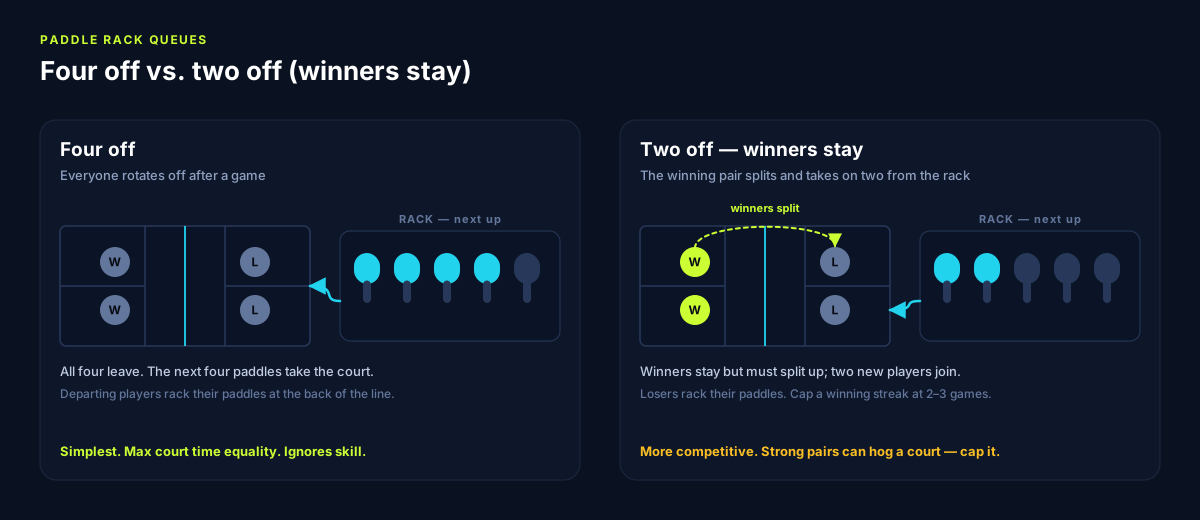
How it works. A rack (a board with slots, a PVC frame, or a fence) holds paddles in order. When a game ends, all four players come off, put their paddles at the back of the queue, and the first four paddles in line go on.
Best for. Any size of group with roughly similar skill; 8–16 players on two courts is the sweet spot. Public courts almost always run this.
Why it works. Court time is perfectly equal, nobody has to organize anything, and a newcomer understands it in ten seconds.
Where it fails. Games are random, so a 3.0 foursome plays a 4.5 foursome and both hate it. The same friends can rack their paddles together every time and never mix. Paddles get moved.
House rules that help. Paddles go in the rack in order of arrival; no saving slots; if you step out, your paddle comes out of the line; games to 11 win by 2, or to 15 with rally scoring when more than 8 are waiting.
2. Paddle rack, two off (winners stay, or challenge court)
How it works. The winning pair stays on, splits up, and each winner partners one of the next two paddles from the rack. The losers go to the back of the line.
Best for. A single "challenge court" at a session where the strong players want more competitive games. Winners stay for a maximum of two or three games, then everyone comes off.
Why it works. Winning is rewarded, games get progressively closer as the strong players gather on the challenge court, and a hot pair gets to test themselves.
Where it fails. As the only system on every court, it lets the best two players monopolize a court for an hour while the beginners queue. Without the "winners split" rule it is worse still.
House rules that help. Winners must split; a cap of three consecutive games; the challenge court is clearly labelled and optional; the other courts run four off.
3. King (or queen) of the court
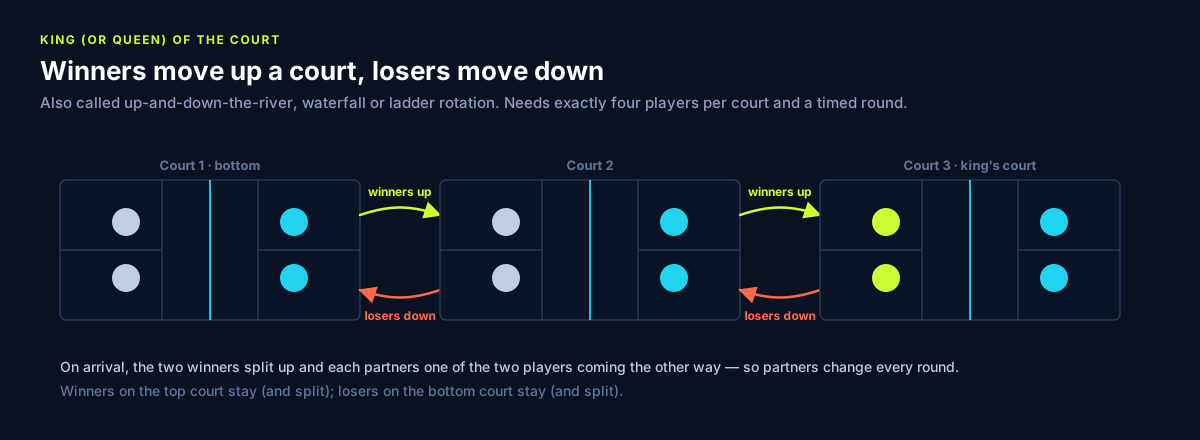
Also called up and down the river, waterfall or ladder rotation.
How it works. Courts are ranked: court 1 is the bottom, the highest-numbered court is the king's court. Everyone plays a timed round (10–12 minutes, or one game to 11). Winners move up a court, losers move down. Winners on the top court stay; losers on the bottom court stay. On arrival, the two players moving in split up and partner the two staying, so partners change every round.
Best for. Groups with exactly four players per court — 8, 12, 16, 20 — and a wide enough skill range that sorting helps. Club nights, not public drop-in.
Why it works. After three or four rounds, the courts have sorted themselves by results: the top court is the best four players that night, the bottom court the four newest, and everyone in between is playing people at their level. Partners rotate. Nobody sits.
Where it fails. It needs the exact player count; a fifth player on a court means a sit-out and the sorting stalls. It also needs a timer and a whistle, because every court must finish together. And it is a sorting mechanism, not a standing: the "winner" is whoever is on the king's court at the end, which is fine for a social night and thin for a league.
Variations. Points-based: each player collects their game scores across rounds, and the standings at the end rank individuals — a king of the court and a round robin hybrid. Seeded: sort players onto courts by rating before round 1 so the first rounds are not a shuffle.
4. Skill-banded racks or courts
How it works. Two or three racks (or two or three groups of courts) labelled by level — 2.5–3.0, 3.25–3.75, 4.0+ — and players queue in the rack for their level. Each rack runs four off.
Best for. Sessions with more than about 16 players and a wide skill spread; any venue with four or more courts.
Why it works. Games are close, beginners get to play, and the strong players stop complaining.
Where it fails. Self-rating. People overestimate by half a level, and the organizer ends up policing the 4.0 rack. A posted, visible rating (DUPR, a club rating, or "ask the organizer to place you") removes the argument. Also: the top rack can run thin at 7 pm and the bottom rack overflow; allow players to step down a rack when theirs is empty.
5. Numbered rotation (organizer-called)
How it works. Everyone gets a number on arrival. The organizer (or a whiteboard) calls the next foursome: "Court 1: 3, 9, 12, 15." Players rotate through by number, and the organizer can balance the foursomes by eye.
Best for. Organized groups of 12–24 with one willing organizer, and any group that wants mixing without the full structure of a round robin.
Why it works. It mixes people, it lets the organizer prevent lopsided games, and the queue is visible.
Where it fails. The organizer does not get to play, the whiteboard gets rained on, and "why did you call her before me?" is a conversation you will have. Writing the next three foursomes on the board, not just one, avoids most of it.
6. Scheduled round robin
How it works. The rotation is decided before the first game: a printed chart or a generator assigns partners, opponents and sit-outs for every round, and everyone knows their court for the whole session.
Best for. Any group that wants equal games, fair sit-outs and mixed partners — club nights, leagues, anything with a standing at the end. 4 to 40 players.
Why it works. It is the only system that guarantees all three fairness goals at once, and it replaces the queue with a schedule. Our round robin guide covers the set-up and the charts for 4 to 16 players give you printable rotations.
Where it fails. It needs a fixed roster for the session, so a public drop-in where people wander in and out is hard to run from a printout. A generator that can redraw the rotation for whoever is there handles it — though redrawing generally clears any scores already entered, so do it between rounds.
7. App-managed queues
How it works. Players check in on a phone or a tablet at the gate; the app assigns the next foursome from a queue ordered by time since last game, optionally balancing by rating and avoiding repeat partners.
Best for. Groups above about 16 with mixed skills and a recurring session, or a facility with many courts.
Why it works. The queue is objective and visible to everyone, latecomers are slotted in fairly, and nobody has to stand by the rack.
Where it fails. It needs a charged device and someone who runs it; if the organizer is also playing, the app needs to be self-service.
Comparing the systems
| System | Equal court time | Close games | Mixing | Needs | Best size |
|---|---|---|---|---|---|
| Four off | Excellent | Random | Random | A rack | Any; 8–16 per 2 courts |
| Two off / winners stay | Poor | Improves over time | Some (winners split) | A rack + a cap | One challenge court |
| King of the court | Excellent (no sit-outs) | Good after 3 rounds | Good (partners change) | Exactly 4 per court, a timer | 8, 12, 16, 20 |
| Skill-banded racks | Good within a band | Good | Random within a band | Honest ratings, 4+ courts | 16+ |
| Numbered rotation | Good | Organizer-dependent | Good | A whiteboard and a non-playing organizer | 12–24 |
| Scheduled round robin | Perfect | Good with ratings | Perfect | A chart or generator; a fixed roster | 4–40 |
| App queue | Excellent | Good with ratings | Good | A device, a check-in habit | 16+ |
The wait-time math
However you rotate, the waiting is arithmetic. With four-off, the number of "rounds" it takes for everyone to play once is players ÷ (4 × courts), and the wait between your games is one round less than that:
Wait between games ≈ (players ÷ (4 × courts) − 1) × game length
| Players | Courts | On court | Waiting | Wait between games (15-min games) |
|---|---|---|---|---|
| 8 | 2 | 8 | 0 | 0 |
| 12 | 2 | 8 | 4 | ~8 min |
| 16 | 2 | 8 | 8 | 15 min |
| 20 | 2 | 8 | 12 | ~23 min |
| 16 | 4 | 16 | 0 | 0 |
| 24 | 4 | 16 | 8 | ~8 min |
| 32 | 4 | 16 | 16 | 15 min |
| 40 | 4 | 16 | 24 | ~23 min |
Two levers shorten the wait: more courts, or shorter games. Games to 11 win by 2 run 15–25 minutes; a timed 10-minute round roughly halves that, and rally scoring to 15 (12–20 minutes) takes a little off and makes the length predictable. When more than eight people are waiting, shorten the games.
Choosing a system
- Public courts, strangers, any number: four off, with a rules board.
- 8, 12 or 16 players, mixed skills, club night: king of the court with 10-minute rounds, or a scheduled round robin with ratings.
- 20+ players, mixed skills: skill-banded racks (four off within each), or an app queue.
- Regulars who want close games and a standing: a scheduled round robin, rating-balanced.
- A competitive core inside a social session: one challenge court (two off, winners split, cap of three) plus four off everywhere else.
- A season: a ladder or league — see how to run a league or ladder.
House rules and etiquette
Post them. A laminated sheet on the rack ends most disputes before they start.
- Paddles in the rack in arrival order. The rack is the queue; people are not.
- No saving slots, no stacking. You may rack your paddle next to a friend's, but four friends racking together to stay a foursome is what four off is designed to prevent — most groups allow pairs, not fours.
- Four off unless the court is labelled otherwise. Challenge courts are the exception and they are labelled.
- Game length is posted: to 11 win by 2 when fewer than 8 are waiting; to 11 with a cap at 13, or rally to 15, when more are.
- Step out, step back. If you leave the line, your paddle comes out; when you return, it goes to the back.
- Winners report, everyone calls their own lines. Replay any honest disagreement.
- Doubles has priority on shared public courts when people are waiting — many municipal rule boards say exactly this, limiting play to groups of four once the courts are full.
- Newcomers get placed. Someone greets new players, explains the system in two sentences and helps them pick a rack.
Common problems and fixes
The same four never leave court 2. They are running two off on their own. Label the courts and enforce four off, or give them a challenge court with a cap.
The strong players won't play with beginners. Band the racks, or run king of the court so the sorting happens by results rather than by refusal.
Paddles keep getting moved. Take a photo of the rack every few games (some groups do), or move to a whiteboard or app queue where the order is written down.
Thirty-minute waits. Shorten the games (rally to 15, or timed 10-minute rounds) and check the wait-time table; at 24 players on two courts no rotation system can save you — you need courts, or two sessions.
Nobody knows who is next. The system must answer "am I next?" without a conversation. A rack does; a vague line does not.
A fifth player on a king-of-the-court court. Move to the points-based variation for the night, or send the fifth to the bottom court as a rotating sit-out.
Frequently asked questions
What is paddle stacking in pickleball?
Paddle stacking (or paddle racking) is the open play queue: players put their paddles in a rack in order of arrival, and when a court opens the next four paddles in line take it. "Four off" means all four players leave after a game; "two off" means the winners stay and split up to take on the next two.
What is the difference between four off and two off?
Four off sends all four players to the back of the queue after every game, so court time is equal and games are random. Two off keeps the winning pair on court (usually split up) and brings on two new players, which rewards winning but lets strong players hold a court. Most groups run four off on every court and allow two off only on a labelled challenge court with a cap.
How does king of the court work in pickleball?
Courts are ranked from bottom to top. Everyone plays a timed round; winners move up a court and losers move down, with the winners on the top court and losers on the bottom court staying put. Incoming players split up and partner the players already there, so partners change every round. It needs exactly four players per court and a timer.
What is the fairest open play rotation?
A scheduled round robin: everyone plays the same number of games, sit-outs rotate, and partners and opponents are spread evenly. Among queue systems, four off is the fairest for court time; king of the court is the fairest for close games once it has sorted the courts.
How do you handle different skill levels at open play?
Band the racks or courts by level (with a visible rating, not just self-rating), run king of the court so results sort the courts, or run a rating-balanced round robin. Random four off with a wide skill spread produces the lopsided games that make beginners leave.
How long should games be at open play?
Games to 11, win by 2, when fewer than eight people are waiting. When the queue is longer, cap at 13, switch to rally scoring to 15, or run timed 10-minute rounds. With 16 players on two courts (8 waiting), each 15-minute game means a 15-minute wait; 10-minute games make it 10.
Keep reading
- Round robinHow to Set Up a Pickleball Round Robin (Formats, Rounds, Courts and Fair Rotations)A step-by-step guide to running a pickleball round robin for 4 to 40+ players — the five round robin formats, how many rounds and courts you need, how to handle sit-outs and odd numbers, which scoring to use, and how to pick a winner without an argument.
- EtiquettePickleball Etiquette: The Written Version of the Unwritten RulesThe unwritten rules of pickleball, written down — line calls and honest doubt, "ball on!" and court safety, crossing behind live courts, open play and paddle rack manners, partner and opponent etiquette, and what an organizer should actually enforce, with a code of conduct you can copy for your group.
- ChartsPickleball Round Robin Charts for 4 to 16 Players (Printable Rotation Schedules)Ready-to-print pickleball round robin rotation charts for 4, 5, 6, 7, 8, 9, 10, 11, 12, 13, 14, 15 and 16 players on 1 to 4 courts. Every chart gives everyone the same number of games, rotates sit-outs fairly and keeps partner repeats to the minimum — with the exact fairness stats for each one.
- Groups & communityHow to Start a Pickleball Group (and Keep People Coming Back)A practical playbook for starting a pickleball group from scratch — finding courts and your first 8 players, picking a weekly format, handling skill levels and no-shows, choosing one communication channel, and the engagement habits that turn a pickup session into a community that runs itself.