Etiquette
Pickleball Etiquette: The Written Version of the Unwritten Rules
The unwritten rules of pickleball, written down — line calls and honest doubt, "ball on!" and court safety, crossing behind live courts, open play and paddle rack manners, partner and opponent etiquette, and what an organizer should actually enforce, with a code of conduct you can copy for your group.
Updated 8 min readBy the PicklePal team
On this page
Every sport has two rulebooks. Pickleball's official one covers the kitchen and the double bounce; the second one — who calls the ball out, who fetches the stray, who plays next — is unwritten, learned by watching, and enforced by nothing but atmosphere. New players break it invisibly and get frozen out without knowing why. Organizers who never post it end up refereeing arguments that a laminated sheet would have prevented.
This is the second rulebook, written down: the norms as they are actually practiced at courts and open play, why each exists, and the short list an organizer should actually enforce. It ends with a code of conduct you can copy for your group.
The four moments that matter most
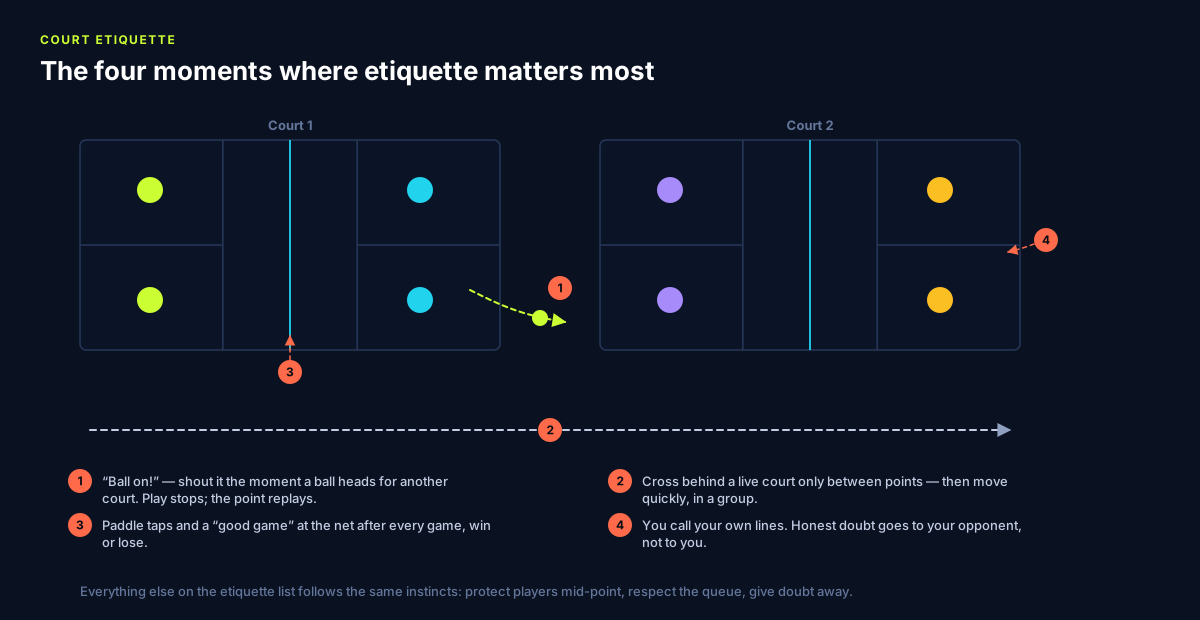
Nearly every rule below is one of these four in disguise; the rest is queue manners, which get their own section.
Line calls and score calls
The honor system is the sport. It survives because of three habits:
- You call the lines on your side of the net. Your opponent's shot near your baseline is your call, not theirs — and the reverse. Asking your opponent's opinion is fine; they give an honest answer or say they could not see.
- "Out" means you saw it out. Not "it felt long," not "it usually would be." This is not merely etiquette — it is rule 8.D, the rulebook's Code of Ethics for Line Calling: "all questionable calls must be resolved in favor of the opponent… Any ball that cannot be promptly called 'out' must be considered 'in.'" Rule 8.E adds that you must not call a ball out unless you can clearly see space between the line and the ball.
- Call your own faults. Foot in the kitchen on a volley, a double bounce your opponent could not see, a serve you clipped — say it. It costs one rally and buys you a reputation.
Call the score, loudly, before every serve. Most score disputes are just a serve struck before anyone agreed what the score was. If a dispute survives honest discussion, replay the point — the universal rec-play resolution, and worth knowing it is the opposite of the officiated rule, where a call nobody can make is ruled "in." In an organized event, whatever the posted rules sheet says goes. (For events, put the resolution on the sheet: our rules one-pager has a line for it.)
Disagreeing with a call happens. The etiquette is one respectful question ("you're sure on that one?"), acceptance of the answer, and no relitigating between points. Repeated bad calls are an organizer conversation, not an on-court prosecution.
Safety: the rules nobody gets to opt out of
- "Ball on!" The moment any ball rolls toward an occupied court — yours or a neighbor's — the shout goes up and play on that court stops immediately. The point is replayed, always, even at game point. A rolled ball under a moving player is how wrists and hips get broken; this is the one rule with zero social flexibility.
- Return strays properly. Wait for the neighboring point to end, then roll or toss the ball to a player who is looking at you — never fling it blind across their court mid-rally.
- Cross between points. Walking behind a live court, wait for the rally to finish, then cross quickly, together, behind the baseline. On a multi-court walkway, glance before you step.
- Don't play through people. If a player from the next court chases a lob into your court, stop your rally and replay it. Same answer as ball on: a body is on the court.
- Control the paddle and the temper. No thrown paddles, no balls smashed away in anger, no tagging opponents at close range harder than the point requires when a soft angle wins it just as well. Overhead winners happen; head-hunting is remembered.
Open play and the paddle rack
Open play etiquette is queue etiquette. The details of every rotation system are in open play rotation systems; the manners are the same in all of them:
- Rack in arrival order. No sliding your paddle up the line, no "holding" a slot for someone parking the car. Pairs may rack together where the house allows it; racking four together to keep a private foursome defeats the whole system.
- Four off means four off. When the game ends, everyone leaves — no "quick second game," no lingering at the net until your friends reach the front. Winners feeling entitled to stay is one of the most reliable sources of open-play friction.
- Play the level on the sign. If courts are banded, respect the band — both directions get noticed: dropping down to dominate a beginner court, and pushing into an advanced one you cannot hold.
- Games to the posted score. When a crowd is waiting, the queue outranks your deuce battle: play the cap.
- Welcome the joiner. Three players hoping to keep a court have an obligation to the first paddle in the rack, not to their missing friend. And when a stranger's paddle comes up, the greeting — names, quick warm-up, "we're playing to 11" — costs thirty seconds and defines the venue.
- Leaving early? Come off between games, take your paddle out of the rack, and tell whoever tracks the rotation, so nobody builds a game around a player who has gone home. (In an organized session, tell the desk — a sign-in sheet with an OUT column exists for exactly this.)
Partners and opponents
- No unsolicited coaching. One of the most cited unwritten rules in the sport. Advice is a gift given when requested; between rallies, "great get" is a complete sentence. This applies double to partners you outrank.
- Errors get silence or encouragement. Eye-rolls at your partner are visible from every court and remembered longer than the score.
- Warm up the game everyone came for. A couple of minutes of dinks and drives before the first serve, shared — not twenty minutes of drilling while three people wait.
- Paddle taps at the net, every game. Win or lose, taps (or the raised-paddle nod from introverts) and a "good game." Skipping it after a loss reads exactly like it reads in every other sport.
- Compliment the opponent's winner. "Too good" is the sport's native phrase, and it costs nothing.
- Spectating? Cheer good rallies for both sides, stay off the fence line players use for room, and never call lines from the sideline unless asked.
What organizers should actually enforce
A group's culture is set by what its organizer tolerates. But not every norm above deserves enforcement — a session where the organizer polices paddle-tap sincerity is worse than one with none. The workable split:
Enforce without discussion: ball-on stops play; crossing waits for the point; rack order; four off; the posted level bands; no thrown paddles. These protect bodies and fairness, and one calm, consistent sentence does it: "House rule — next four paddles are up."
Model, don't police: generous line calls, no coaching, welcoming newcomers, paddle taps. Organizers who do these loudly find the group copying them within weeks.
Put it in writing once: a code of conduct pinned where people sign up ends the "nobody told me" defense. Copy this one:
For running the fair-rotation half of that promise — equal games, no court camping — a posted rotation does more than any speech: see the open play poster and the round robin guide.
Common breaches, graded
| Breach | Severity | The fix |
|---|---|---|
| Calling a ball out that you hoped was out | High — it is the honor system | Doubt goes to the opponent; call it on yourself once and the habit sticks |
| Playing through a "ball on" | High — injury risk | Stop instantly, replay, no exceptions |
| Winners staying on at four-off open play | Medium — queue theft | Organizer's one sentence; the poster on the fence |
| Coaching a stranger mid-game | Medium — the classic | "Thanks — I'm just going to play it out" is a full answer |
| Sandbagging the beginner court | Medium | Move up when asked; results speak |
| Crossing behind a live rally | Medium — safety adjacent | Wait one point; cross fast |
| Skipping paddle taps after a loss | Low but visible | Tap anyway; it is the sport's handshake |
| Loud score disputes | Low | Call the score before every serve; replay honest disagreements |
Frequently asked questions
What are the unwritten rules of pickleball?
The core set: call your own lines and give any doubt to your opponent; shout "ball on!" and stop play when a ball enters a court; cross behind courts only between points; respect the open-play queue (rack in order, four off); call the score before serving; no unsolicited coaching; and paddle taps at the net after every game.
Who calls the ball in or out in pickleball?
The player or team on whose side the ball lands makes the call — you call the lines on your side of the net. Rule 8.D puts it plainly: questionable calls are resolved in favour of the opponent, and any ball that cannot be promptly called "out" is in.
What does "ball on" mean in pickleball?
It is the safety shout used when a ball rolls onto a court where a rally is happening. Play stops immediately and the point is replayed — no arguing, no playing it out — because stepping on a loose ball mid-motion is the sport's classic serious injury.
What is proper etiquette at pickleball open play?
Put your paddle in the rack in arrival order, come off with all four players when your game ends, play to the posted score when people are waiting, respect any skill-level court labels, welcome whoever the rack sends you, and take your paddle out of the line if you leave. The rack is the queue; people are not.
Is it rude to give advice during a pickleball game?
Unrequested coaching is among the most commonly cited etiquette breaches in the sport. Compliments are always welcome; instruction waits until someone asks for it — including from partners.
What should a pickleball group put in its code of conduct?
Line-call honesty, the ball-on rule, queue rules (rack order, four off), level-band respect, no unsolicited coaching, no temper the court has to absorb, and who decides on the day plus what happens on repeat issues. Keep it under 120 words, pin it where people sign up, and have the organizer model it visibly.
Keep reading
- Open playPickleball Open Play Rotation Systems: Paddle Stacking, King of the Court, Challenge Courts and MoreEvery way to rotate players through courts at pickleball open play — four-off paddle racks, two-off winners-stay, king of the court, skill-banded racks, numbered rotations, scheduled round robins and app queues — with how each works, the wait-time math, which one fits your group size and skill spread, and the house rules that stop the arguments.
- Groups & communityHow to Start a Pickleball Group (and Keep People Coming Back)A practical playbook for starting a pickleball group from scratch — finding courts and your first 8 players, picking a weekly format, handling skill levels and no-shows, choosing one communication channel, and the engagement habits that turn a pickup session into a community that runs itself.
- Rules & scoringPickleball Tiebreakers and Scoring Formats Explained (Head-to-Head, Point Differential, Rally Scoring, Caps and Skinny Singles)How to score a pickleball event and settle the standings — side-out vs rally scoring, games to 11, 15 or 21, win-by-2 caps, timed rounds and best-of-three; then the USA Pickleball tiebreaker order (head-to-head, point differential, head-to-head differential) with worked two-way and three-way examples, individual standings for rotating-partner events, and when to use a skinny singles play-off.
- PrintablesFree Pickleball Printables: Score Sheets, Pool Sheets, Brackets, Sign-In Sheet and Rotation PosterNine free, print-ready PDFs for pickleball organizers — a round robin score sheet, pool play sheets for pools of 4 and 5, single-elimination brackets for 4, 8 and 16 teams, a player sign-in sheet, an open play rotation poster and a fill-in rules one-pager — plus how to use each one so the paper runs the event for you.