Rules & scoring
Pickleball Tiebreakers and Scoring Formats Explained (Head-to-Head, Point Differential, Rally Scoring, Caps and Skinny Singles)
How to score a pickleball event and settle the standings — side-out vs rally scoring, games to 11, 15 or 21, win-by-2 caps, timed rounds and best-of-three; then the USA Pickleball tiebreaker order (head-to-head, point differential, head-to-head differential) with worked two-way and three-way examples, individual standings for rotating-partner events, and when to use a skinny singles play-off.
Updated 11 min readBy the PicklePal team
On this page
Two things end a pickleball event in an argument: a scoring rule nobody announced, and a tie nobody planned for. Both are avoidable with one printed sheet.
This guide is that sheet, explained. The first half covers the scoring formats you can choose for an event and how long each one takes. The second half covers standings and tiebreakers, with worked examples for the cases that actually come up — the two-way tie, the three-way circle, and the individual tie in a rotating-partner round robin.
Part 1: Scoring formats
Side-out scoring (traditional)
Only the serving side can score. In doubles each side gets two serves per side-out (except the very first service of the game, which gets one), and the score is called as three numbers: serving team's score, receiving team's score, server number — so every game starts "zero–zero–two."
Games go to 11, win by 2, for recreational play and most round robins. Tournaments also use games to 15 or 21. It is the scoring everyone knows, and its only drawback as an event format is length: a game to 11 can take 8 minutes or 25, because long stretches of side-outs add no points.
Rally scoring
A point is scored on every rally, whichever side served. The score is called as two numbers. Games are typically to 15 or 21, win by 2, though 11 is also used.
USA Pickleball first added rally scoring as a provisional rule for 2025, and carried it into 2026 in restructured form (rules 14.A and 15.C.2, both still flagged "Provisional Rule"). A tournament director may choose one game to 11, 15 or 21, or best two-of-three (or three-of-five) games to 11, 15 or 21, win by 2. It is excluded from double-elimination doubles events, Golden Ticket events and the National Championships, and USA Pickleball will decide in 2027 whether to extend the provisional period, make it permanent or discontinue it.
The big 2026 change is that the freeze is gone. The 2025 rule read "a point for each rally won except game point is scored only when serving"; the 2026 rule (14.A.2) reads "A point is scored by the singles player or doubles team that wins each rally" — so the receiving side can now win the game. One quirk worth announcing: in rally-scoring doubles only one player per team serves before a side out (14.A.5).
Some leagues still use a freeze variant — the rule USA Pickleball itself used in 2025, and the one Major League Pickleball popularized: a team at game point can only win the game on its own serve. It adds drama to the finish and a few minutes to the game. Say which version you are using.
Why organizers like rally scoring: a game to 15 finishes in a far narrower window than a side-out game to 11 — typically 12–20 minutes — which is what makes a multi-court schedule hold together. Why some players do not: the serving team loses a point on its own error, which changes strategy, and the familiar three-number call goes away.
Caps: win by 2, up to a limit
A cap keeps win-by-2 but ends the game at a fixed score. "Games to 11, win by 2, cap at 15" means 12–10 and 13–11 are wins, and at 14–14 the next point wins. A hard cap — "first to 11, win by 1 at 13" — is the same idea with a shorter leash.
Caps cost almost nothing in fairness and stop the one 17–15 game that holds up four courts. They are the easiest change for a round robin with more than two courts.
Timed rounds
Everyone starts together; a horn or timer ends the round at 10–15 minutes. Common rules for the horn: finish the point in progress; the side ahead wins; if tied, either both sides take half a win, play one deciding rally, or record a draw. State which.
Timed rounds make an event run exactly to schedule — rounds × round length — and suit open play, king of the court and large round robins. They do produce the occasional 4–3 "win," so rank by wins and point differential rather than raw points.
Single game or best of three
Best two-of-three games to 11 is the first of the four standard tournament formats in the rulebook (15.C.1) and the fairest, because one bad game does not decide it. It also takes 40–75 minutes per match; a straight-games win finishes under 45. A common compromise: single games to 11 or 15 in pools, best of three in the bracket, best of three in the final.
Skinny singles
Singles played on half the court. Three variants are in common use: down the line (both players on the same half), crosscourt (diagonal halves), or switching sides by the server's score as in full singles. That third one is the version USA Pickleball has codified, as mini-singles (rule 14.B), where the server's and receiver's positions are set by their individual scores; the fixed-half versions are house variants. Everything else follows singles rules — one serve, the two-bounce rule, side-out scoring or rally.
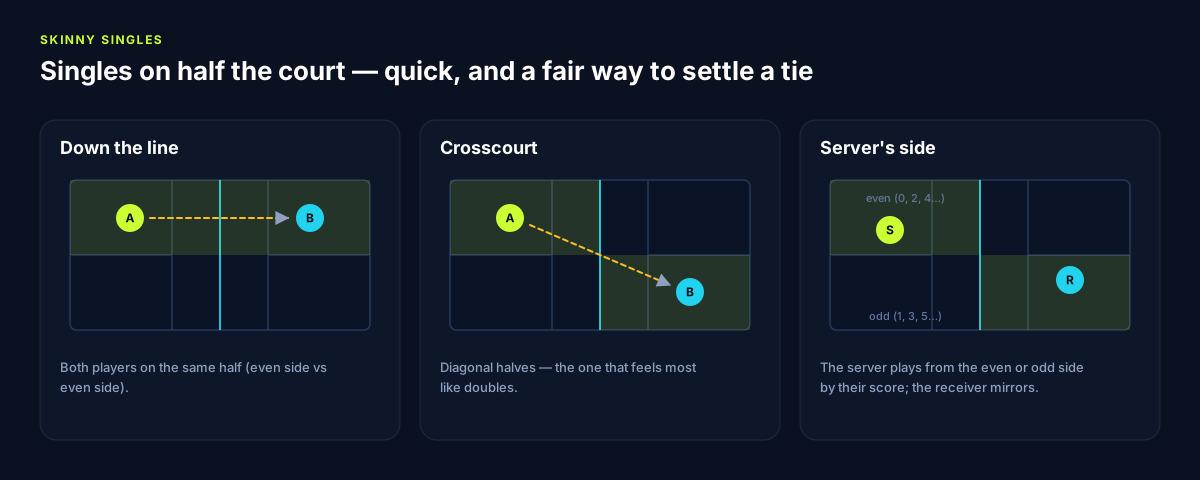
It is a drill, a format in its own right for small groups, and — because it is quick and one-on-one — the cleanest way to break an individual tie.
Which format, when
| Format | Typical rec doubles length | Predictable? | Use it for |
|---|---|---|---|
| To 11, win by 2 (side-out) | 15–25 min | No | 1–2 courts; pools with time to spare |
| To 11, win by 2, cap 15 | 15–22 min | Mostly | Round robins on 3+ courts |
| To 11, win by 1 at 13 (hard cap) | 12–18 min | Yes | Busy open play, big round robins |
| Rally to 15, win by 2 | 12–20 min | Yes | Leagues, multi-court events, newer players |
| Rally to 21, win by 2 | 18–22 min | Yes | A longer game when time allows |
| Timed 12-minute rounds | 12 min | Exactly | King of the court, 20+ players, fixed finish |
| Best of 3 to 11 | 40–75 min | No | Tournament brackets and finals |
| Skinny singles to 7 | A few minutes | Yes | Tiebreakers, odd-player sessions, drills |
Part 2: Standings and tiebreakers
What gets counted
- Wins (or win percentage when games played differ).
- Point differential (PD): points scored minus points allowed, summed over all games. Win 11–7 and lose 9–11: PD = +4 − 2 = +2.
- Points for (PF) and points against (PA): the two halves of PD, occasionally used as a further tiebreak.
- Head-to-head (H2H): the result of the game(s) between the tied teams only.
Rank by wins first. Point differential rewards close losses over blowouts and is the universal second criterion. Ranking by total points, which some casual groups do, rewards running up the score and punishes a player who sat out a round — avoid it.
The USA Pickleball order (rule 15.B.4)
For round robin and pool play, the 2026 rulebook's tiebreak sequence is five steps:
- Head-to-head matches won among the tied teams (15.B.4.b).
- Point differential across all games played (15.B.4.c).
- Head-to-head point differential among the tied teams (15.B.4.d).
- Point differential against the next-highest-placed team — how each tied team did against the team just above them (15.B.4.e).
- Total points scored across all matches (15.B.4.f).
Two things changed for 2026 that catch people out. Steps 2 and 5 do not apply across pools of unequal size — you cannot compare point differential between a pool of 4 and a pool of 5. And there is no longer any instruction to restart the sequence: the step that succeeds ranks all the tied teams, and any teams still level continue down the list rather than going back to the top.
A withdrawal is now more drastic than a tiebreak exclusion. Under 15.B.4.a, a player or team that withdraws, retires or is forfeited from a round robin has their match results struck from the standings entirely and is ineligible for any playoff or medal match — though those results still count toward their rating.
Most leagues and clubs copy this order. Whatever order you use, print it.
Two-way tie
Two teams finish 3–1 in a pool of 5. They played each other; the team that won that game ranks higher. Done. Head-to-head settles almost every two-way tie; only a double round robin where they split the games goes on to point differential.
Three-way tie
Three teams finish 2–1 in a pool of 4, and each beat one of the others — Red beat Blue, Blue beat Green, Green beat Red. Head-to-head is circular (each is 1–1 against the others), so it cannot break the tie. Move to point differential across all games.
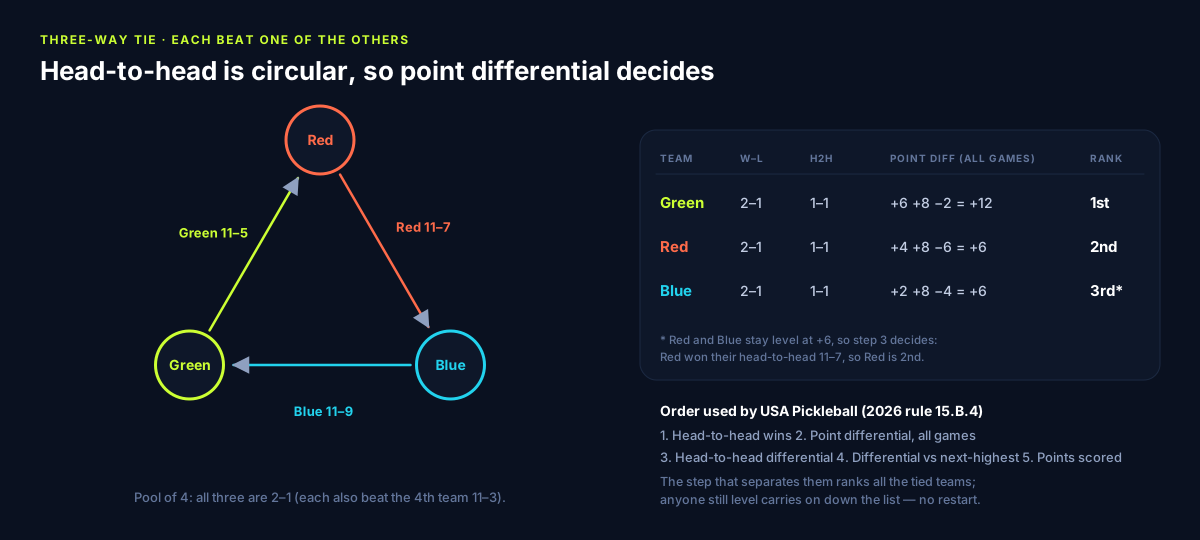
Worked through:
| Team | Record | Results | PD (all games) |
|---|---|---|---|
| Green | 2–1 | beat Red 11–5, beat Team D 11–3, lost to Blue 9–11 | +6 +8 −2 = +12 |
| Red | 2–1 | beat Blue 11–7, beat Team D 11–3, lost to Green 5–11 | +4 +8 −6 = +6 |
| Blue | 2–1 | beat Green 11–9, beat Team D 11–3, lost to Red 7–11 | +2 +8 −4 = +6 |
Green is first on point differential. Red and Blue are still level at +6, so they continue down the list to step 3 — head-to-head point differential. Red beat Blue 11–7, so Red is +4 and Blue is −4: Red second, Blue third.
Note the 2026 sequence does not send you back to the top. Under the pre-2026 rulebook you restarted at head-to-head for the remaining tie, which in this example happened to give the same answer; the current rule simply carries on to steps 3, 4 and 5.
Individual standings in rotating-partner events
When partners rotate, every player's record is their own: a win for the team is a win for both players. The same criteria apply, in a slightly different order — wins, then point differential, then points scored.
Two wrinkles:
- Head-to-head is murky. Two players may have met twice, once as opponents and once as partners. Many organizers skip head-to-head for individuals and go straight to point differential, then points for. Software often keeps it — PicklePal's standings apply wins, then win percentage, then head-to-head, then differential, then points for, in every format — so if you have announced the simpler order, check the top of the table before you read the results out.
- Dead ties happen. With eight players over seven games it is common for two to finish with the same wins and the same differential. Rather than a coin flip, play it off: skinny singles to 7 (or to 11 if time allows) on half a court is over in a few minutes and settles the seeding on court. In pool play with a playoff, this matters — it decides who advances and who they partner.
Uneven games played
Late arrivals and early leavers leave some players with fewer games. Rank by win percentage and point differential per game rather than raw totals, or require a minimum number of games to appear in the standings (two-thirds of the rounds is a common floor). Say which before the session.
Points-based ladders
Ladders often skip wins entirely and award points won out of points available: a player who loses 9–11 earns more than one who loses 3–11, and every point in every game matters. Small bonuses for a win or for playing on a higher court are common. It is a fair system for weekly movement between boxes, and it needs no tiebreaks beyond the points themselves. See how to run a league or ladder.
Part 3: A rules sheet you can copy
| Event | Scoring | Standings | Tiebreaks |
|---|---|---|---|
| Social round robin, 2 courts | To 11, win by 2 | Wins | PD → points for → skinny singles for 1st |
| Round robin, 3+ courts | To 11, win by 2, cap 15 | Wins | PD → points for |
| Timed open play / king of the court | 12-minute rounds, side ahead wins, tie = half each | Wins | PD |
| Pool play (fixed teams) | Pools to 11 or 15; bracket best of 3 to 11 | Wins | USA Pickleball order |
| Pool play (rotating partners) | Pools to 11 (cap 13) | Individual wins | PD → points for → skinny singles to 7 |
| League night | Rally to 15, win by 2 | Wins, season table | Teams: USA Pickleball order (15.B.4) · Individuals: PD → points for |
| Ladder | Rally to 15 or 21 | Points won ÷ points available | — |
| Tournament bracket | Best of 3 to 11, win by 2 | — | — |
Common mistakes
- Announcing the scoring after the first dispute. Print it; pin it; repeat it at the start.
- Total points as the ranking. Blowouts win, close games lose, sit-outs are punished.
- Head-to-head for a three-way tie. It is circular; go to point differential.
- Changing the cap mid-session because one court is slow. Cap from the start or not at all.
- Coin flips for seeding in rotating pools. A five-minute skinny singles game is fairer and more fun.
- Skinny singles play-offs for fixed teams. Almost never needed; teams have head-to-head and differential.
Frequently asked questions
How do you break a tie in a pickleball round robin?
Use the USA Pickleball order (2026 rule 15.B.4): head-to-head result between the tied teams, then point differential across all games, then head-to-head point differential, then point differential against the next-highest-placed team, then total points scored. Work down the list — the step that separates them ranks all the tied teams, and anyone still level carries on down rather than restarting.
What is point differential in pickleball?
Points scored minus points allowed, summed across all of a team's games. A team that wins 11–7 and loses 9–11 has a point differential of +2. It rewards close losses over blowouts and is the standard second tiebreaker after wins.
Does head-to-head come before point differential?
Yes, in the USA Pickleball order head-to-head is first. For a two-way tie it almost always decides. For a three-way tie where each team beat one of the others, head-to-head is circular and point differential decides.
What is the difference between rally scoring and side-out scoring?
In side-out scoring only the serving side can score, and games go to 11 win by 2. In rally scoring every rally scores a point for whichever side wins it, games usually go to 15 or 21, and game length becomes predictable. USA Pickleball made rally scoring a provisional tournament option in 2025 and removed its "freeze" for 2026, so either side can now win the game on any rally.
What is a cap in pickleball scoring?
A maximum score at which the game ends even without a two-point margin. "To 11, win by 2, cap 15" means the first side to 15 wins regardless. Caps keep a multi-court round robin on schedule.
What is skinny singles and why is it used as a tiebreaker?
Singles played on half the court — USA Pickleball codifies it as mini-singles (rule 14.B). It is quick, one-on-one, and needs no partner, which makes it the fair way to settle a tie between two individuals in a rotating-partner round robin or pool.
How do you rank players when some played fewer games?
Rank by win percentage and point differential per game rather than raw totals, or set a minimum number of games to be ranked. Announce the rule before the session starts.
Keep reading
- Pool playHow to Set Up Pickleball Pool Play (Pool Sizes, Seeding, Tiebreakers and the Playoff)How to run pickleball pool play that finishes on time — choosing pool sizes, snake-seeding by rating, scheduling the round robin inside each pool, breaking ties the USA Pickleball way, and crossing the top finishers into a playoff bracket. Covers fixed-partner pools and rotating-partner pools with an individual table.
- Round robinHow to Set Up a Pickleball Round Robin (Formats, Rounds, Courts and Fair Rotations)A step-by-step guide to running a pickleball round robin for 4 to 40+ players — the five round robin formats, how many rounds and courts you need, how to handle sit-outs and odd numbers, which scoring to use, and how to pick a winner without an argument.
- PrintablesFree Pickleball Printables: Score Sheets, Pool Sheets, Brackets, Sign-In Sheet and Rotation PosterNine free, print-ready PDFs for pickleball organizers — a round robin score sheet, pool play sheets for pools of 4 and 5, single-elimination brackets for 4, 8 and 16 teams, a player sign-in sheet, an open play rotation poster and a fill-in rules one-pager — plus how to use each one so the paper runs the event for you.
- Leagues & laddersHow to Run a Pickleball League or Ladder (Season Structure, Divisions, Subs, Standings and Playoffs)How to set up a pickleball league or ladder that people re-register for — choosing between a team league, an individual round-robin league, a box ladder and a flex league; season length and divisions by rating; the court and time math; subs, no-shows and forfeits; weekly standings; and a playoff night that ends the season properly.