Leagues & ladders
How to Run a Pickleball League or Ladder (Season Structure, Divisions, Subs, Standings and Playoffs)
How to set up a pickleball league or ladder that people re-register for — choosing between a team league, an individual round-robin league, a box ladder and a flex league; season length and divisions by rating; the court and time math; subs, no-shows and forfeits; weekly standings; and a playoff night that ends the season properly.
Updated 11 min readBy the PicklePal team
On this page
A league is the point where a pickleball group stops being a pickup session and starts being a season: a roster, a table, a night people protect in their calendar. It is also where organizers discover that "just keep a standings sheet" involves subs, no-shows, rain, divisions that are too big, and a final nobody scheduled.
This guide lays out the formats, the season math and the policies that keep a league running with one organizer and a spreadsheet — or one organizer and an app.
League, ladder or flex?
| Format | How it works | Commitment | Best for | Admin load |
|---|---|---|---|---|
| Team league (fixed partners) | Teams play a round robin across the season; standings rank teams | High — both partners every week | Competitive groups; pairs who want to play together | Medium: a fixed schedule, subs are awkward |
| Individual league (rotating partners) | Each night is a round robin within a division; players keep their own record | Medium — you, not a partner | Most club leagues; social-competitive groups | Low: the rotation handles absences |
| Box ladder | Groups of 4–5 play a mini round robin; the winner moves up a box, the last moves down | Low — play when you can | Groups with irregular attendance; continuous play with no season | Low: weekly box assignments |
| Flex league | Players are assigned opponents and arrange their own matches within a window | Self-scheduled | Busy players, singles, small venues | Medium: chasing results |
The deciding question is how much commitment your players will actually give. A team league is the most satisfying and the most fragile: one partner travels for work and the team forfeits three weeks. An individual league absorbs absences because the rotation simply plays without you. A ladder absorbs anything.
For a first season, run an individual league. It feels like the round robin nights people already enjoy, with a table on top.
Step 1: Divisions
Group players by level. Three divisions is typical — something like 2.5–3.0, 3.25–3.75 and 4.0+ — adjusted to who actually signs up. Use DUPR ratings where you have them and results from your own round robin nights where you do not; self-ratings run half a level high.
- 8–12 players per division for a rotating-partner league: 8 is the perfect round robin size on two courts, 12 on three.
- 6–8 per division can work for a ladder or a flex league.
- Fewer than 6? Merge with the neighbouring division and balance the courts by rating instead.
- More than 12? Split into two divisions, or run two sessions.
Decide what happens at the top and bottom of each division next season: promotion and relegation for the top two and bottom two keeps the divisions honest and gives the middle of the table something to play for.
Step 2: Season length and the weekly night
6 to 8 weeks of play plus a playoff week is the most common and the most sustainable. Shorter and the standings do not settle; longer and attendance decays from week five.
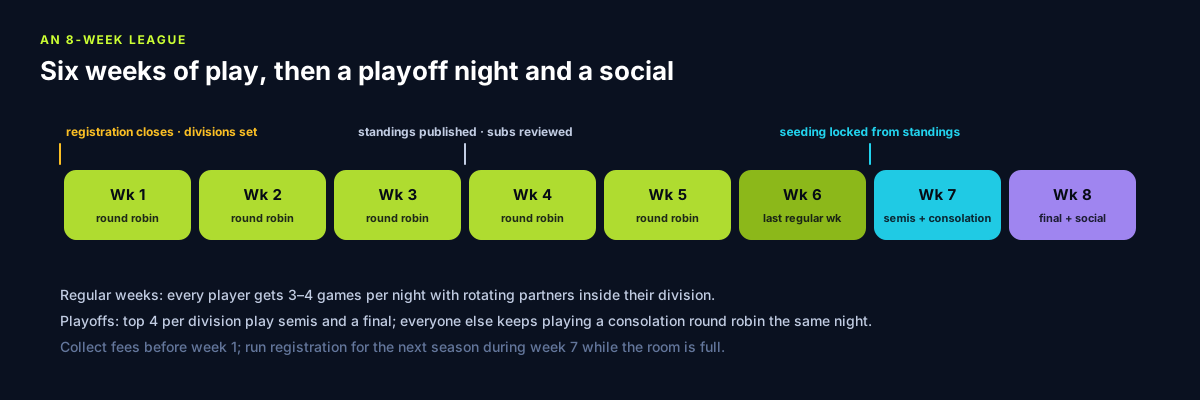
The weekly night should be the same slot for the whole season and should look the same every week:
| Time | What happens |
|---|---|
| 6:45 | Check-in; subs confirmed; courts assigned by division |
| 7:00 | Round 1 (timed 14 minutes, or rally to 15) |
| 7:16 | Round 2 |
| 7:32 | Round 3 |
| 7:48 | Round 4 |
| 8:05 | Scores collected; standings posted in the group chat before people leave |
Four games a night at about 15 minutes each, with changeovers, fits a 75-minute slot. Three games fits an hour.
Courts: each division needs players ÷ 4 courts for nobody to sit — 8 players is 2 courts, 12 is 3. With a number that is not a multiple of four, or with fewer courts, players sit in rotation, which is fine up to one sitter per court.
Step 3: Registration, fees and the policies you need before week 1
Collect name, contact, rating or recent results, the nights they already know they will miss, and payment. Close registration a week before the first night so you can set divisions.
Fees. Club leagues commonly charge in the range of $8–20 per session, usually as a season fee paid up front. Say what it covers — courts, balls, a prize, the end-of-season social — and make the refund policy simple (refunds until registration closes; none after).
The policies, written down and sent with the confirmation:
- Opt-out deadline. "If you cannot make it, opt out by 5 pm the day before." Players who neither opt out nor show are recorded as a forfeit for that night.
- Subs. A sub list of players outside the league (or from a lower division) who can be called in. Decide whether a sub's results count for the absent player (common in team leagues, with a cap), count only for the sub's own fun (common in individual leagues), or count as a forfeit for standings with the sub playing for the night.
- Forfeits. A forfeited game is recorded as 0–11 (or 0–15) so point differential still computes, and counts as a loss.
- Playoff eligibility. A minimum number of nights played — two-thirds of the regular season — to be seeded for the playoffs. It stops a player who came twice and went 8–0 from taking a semi-final spot.
- Make-ups. Rain or a closed gym: the week is either skipped (season shifts a week) or replaced by a double-round night. Say which.
- Scoring and tiebreakers. One line each; see below.
Step 4: The weekly format
Individual league night
Inside each division, run a rotating-partner round robin: a fresh rotation every week so partners and opponents vary, 3–4 games, everyone plays the same number. A printed chart works for a fixed roster; with subs and absences a generator is less work, because it rebuilds the rotation from whoever checked in. The round robin guide and charts for 4 to 16 players cover the mechanics.
Scoring: rally to 15 or timed 14-minute rounds keep four games inside 75 minutes. Record the score of every game against both players on the winning side and both on the losing side.
Team league night
Each week, each team plays one or two fixed-partner games from a season schedule (the circle method: 8 teams play 7 rounds, one per week, which is a season). Best of three to 11 if you have the court time, one game to 15 if you do not. Two games a week against different opponents gets the season done in four weeks for 8 teams, or fills 7 weeks with a double round robin.
Box ladder
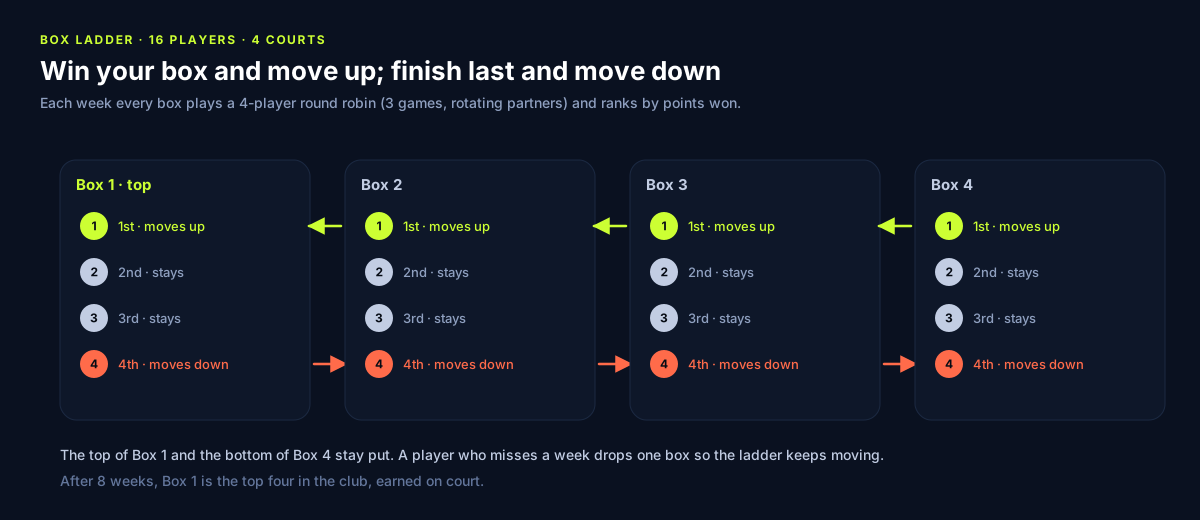
- Sort players into boxes of four (five if numbers force it — a box of five plays five games, one player sitting each game) by rating for week 1.
- Each box plays a 3-game round robin with rotating partners — the perfect 4-player chart: 1 & 2 vs 3 & 4, then 1 & 3 vs 2 & 4, then 1 & 4 vs 2 & 3. Rally to 15 or 21 keeps the boxes in sync.
- Rank within the box by points won divided by points available (a 9–11 loss earns more than a 3–11 loss), with wins as the tiebreak. Some ladders rank by wins then point differential; either works if you say which.
- Movement: the box winner moves up one box, the last-placed player moves down one, the middle two stay. The top of the top box and the bottom of the bottom box stay put.
- Absences: a player who misses a week drops one box (so the ladder keeps moving and the people who showed up move up). New players enter at the bottom box or at a placement box chosen by rating.
- A ladder has no fixed end; declare a "season" of 8 weeks anyway so there is a champion (the top box's winner in the final week) and a reason to re-sort.
Flex league
Publish the pairings for the fortnight — who plays whom — and a deadline. Players arrange their own court and time, play best of three to 11, and report the score. Standings update when results come in. It suits singles and small venues; the admin cost is chasing unplayed matches, so set a rule: an unplayed match by the deadline is a loss for whoever did not offer two times.
Step 5: Standings
Publish every week, the same night, where everyone sees them. The table is the product.
- Team leagues: the USA Pickleball order (rule 15.B.4) — wins, then head-to-head, then point differential. It is written for sanctioned tournaments, but it is the order most leagues borrow. Individual leagues: wins, then point differential, then points scored. Use win percentage when games played differ. The full tiebreak order with worked examples is in tiebreakers and scoring formats.
- Ladders: the box positions are the standings; a running "points ratio" across the season ranks the whole ladder.
- Cap the damage of a missed week: in an individual league, a missed night is simply fewer games (ranked by win percentage), not a set of losses — unless the player failed to opt out.
Step 6: Playoffs
A season without a final is a standings sheet. Give it one.
- Who qualifies: the top four in each division (top two if divisions are small), among players who met the eligibility minimum.
- Format: semi-finals (1 v 4, 2 v 3) and a final, best of three to 11 — semis in week 7 and the final in week 8, or both on the last night if you only have one week. In an individual league, the semi-finalists need partners: the cleanest method is to pair by finishing position — 1st with 4th against 2nd with 3rd for a single final, or draw partners from the next four in the table for two semi-finals.
- Everyone else plays too. A consolation round robin for positions 5 onward on the other courts, the same night, so the final is the closing act of a full evening rather than four people playing while twenty watch.
- Prizes and a social. A small trophy or a paid-for next season for the winner, a photo for the chat, drinks after. Open registration for the next season that night while the room is full.
Worked examples
Common mistakes
- Divisions too wide. One division from 2.5 to 4.5 is a season of blowouts. Split early; merge only when numbers force it.
- No opt-out deadline. You cannot build a fair night for 9 players when 12 said yes and 7 turn up.
- Unwritten sub rules. Decide whether sub results count before the first sub plays.
- Standings published Thursday for a Tuesday league. Post them the same night, every night.
- A season with no ending. Seven weeks, a final, a photo, then the next season. Leagues that just continue fade.
- The organizer also captaining, scoring and playing. Hand the score sheet to a non-playing helper each week, or use a tool that lets players enter their own scores.
Frequently asked questions
What is the difference between a pickleball league and a ladder?
A league has a fixed season, a schedule and a table: you accumulate wins over 6–8 weeks and the top finishers play a final. A ladder is continuous: players are sorted into boxes or ranks, play whoever is in their box when they show up, and move up or down based on results. Leagues suit committed weekly players; ladders suit groups with irregular attendance.
How long should a pickleball league season be?
Six to eight weeks of play plus a playoff week. Shorter and the standings do not settle; longer and attendance falls off. Run back-to-back seasons with a week off between them rather than one long season.
How many players do you need for a pickleball league?
Eight to twelve per division for a rotating-partner league — eight fills two courts with no sit-outs, twelve fills three. A team league wants at least six pairs. A ladder runs with as few as eight players in two boxes.
How do you handle subs and no-shows in a pickleball league?
Set an opt-out deadline the day before. A player who opts out is simply absent (fewer games, ranked by win percentage); a player who neither opts out nor shows records a forfeit. Keep a sub list and decide before the season whether a sub's results count for the absent player, count only for the sub, or count as a forfeit with the sub playing for the night.
How does a pickleball box ladder work?
Players are sorted into boxes of four by level. Each box plays a three-game round robin with rotating partners. The player with the best result (points won, or wins then differential) moves up a box, the last-placed player moves down, and the middle two stay. Absentees drop a box so the ladder keeps moving.
How do you run pickleball league playoffs?
Take the top four in each division among players who met the minimum nights, play semi-finals (1 v 4, 2 v 3) and a final over the last night or two, and run a consolation round robin for everyone else on the other courts. In an individual league, form the playoff pairs by finishing position.
What scoring should a pickleball league use?
Rally scoring to 15 or timed 14-minute rounds for league nights, because four games then fit inside 75 minutes on schedule. Best of three to 11 for playoffs and finals. Rank teams by wins, then head-to-head, then point differential (the USA Pickleball order); rank individuals by wins, then point differential, then points scored.
Keep reading
- Groups & communityHow to Start a Pickleball Group (and Keep People Coming Back)A practical playbook for starting a pickleball group from scratch — finding courts and your first 8 players, picking a weekly format, handling skill levels and no-shows, choosing one communication channel, and the engagement habits that turn a pickup session into a community that runs itself.
- Round robinHow to Set Up a Pickleball Round Robin (Formats, Rounds, Courts and Fair Rotations)A step-by-step guide to running a pickleball round robin for 4 to 40+ players — the five round robin formats, how many rounds and courts you need, how to handle sit-outs and odd numbers, which scoring to use, and how to pick a winner without an argument.
- Rules & scoringPickleball Tiebreakers and Scoring Formats Explained (Head-to-Head, Point Differential, Rally Scoring, Caps and Skinny Singles)How to score a pickleball event and settle the standings — side-out vs rally scoring, games to 11, 15 or 21, win-by-2 caps, timed rounds and best-of-three; then the USA Pickleball tiebreaker order (head-to-head, point differential, head-to-head differential) with worked two-way and three-way examples, individual standings for rotating-partner events, and when to use a skinny singles play-off.
- TournamentHow to Run a Pickleball Tournament (Formats, Divisions, Court Math, Scheduling and a Day-Of Checklist)The organizer's guide to running a pickleball tournament, from an 8-team club championship to a sanctioned multi-division event — picking a format, sizing divisions, doing the court and time math, seeding brackets, setting scoring rules, staffing the day and avoiding the mistakes that put you two hours behind by lunch.