Tournament
How to Run a Pickleball Tournament (Formats, Divisions, Court Math, Scheduling and a Day-Of Checklist)
The organizer's guide to running a pickleball tournament, from an 8-team club championship to a sanctioned multi-division event — picking a format, sizing divisions, doing the court and time math, seeding brackets, setting scoring rules, staffing the day and avoiding the mistakes that put you two hours behind by lunch.
Updated 14 min readBy the PicklePal team
On this page
- Decide what kind of tournament you are running
- Choose the format
- Size the divisions
- Do the court and time math
- Registration, fees and communication
- Seed the brackets and pools
- Set the scoring rules and publish them
- Staff the day
- Budget
- The planning timeline
- Day-of checklist
- Common mistakes
- Frequently asked questions
A pickleball tournament is mostly logistics. The pickleball takes care of itself. What organizers get wrong is the arithmetic: too many teams for the courts, a format that cannot finish before the venue closes, a bracket with a bye in the wrong place, and no plan for the 3.5 mixed division that has 17 teams.
This guide is the arithmetic, plus the checklists we use, from the first planning meeting to the photo with the medals.
If your event is a club night with 12 players rather than a multi-division day, pool play or a round robin may be all you need. Everything below scales down; the planning overhead does not need to.
Decide what kind of tournament you are running
The first decision shapes every other one.
| Type | Typical size | Who it is for | What it needs |
|---|---|---|---|
| Club championship | 8–32 teams, 1–3 divisions | Your own members | 4–6 courts, one day, a director and two helpers |
| Community / charity event | 16–64 teams | The wider area; fundraising | 6–12 courts, registration with payment, sponsors, food |
| Sanctioned tournament | 32–300+ teams | Players chasing ratings and rankings | USA Pickleball sanctioning, memberships, approved balls, a refereeing tier, insurance |
| League finale | 8–16 teams | A league's playoff | Courts you already have; seeding from league standings |
Sanctioning matters only if your players want official ranking points. A sanctioned event applies to USA Pickleball in advance — the request goes in at least 30 days before registration opens — uses an approved ball, requires a current Champion or Challenger membership from every player, and follows the official rulebook and its tournament policies. Refereeing is a tier you choose, not a flat requirement: Standard sanctioning wants a referee for every match, Medal Match Plus reduces that, and there is a No-Referee format. In exchange, results feed national ratings, and the event falls under USA Pickleball's liability and secondary accident insurance — provided you request the certificate of insurance at least 30 days out.
For a first tournament, run unsanctioned. You can still report results to DUPR as a club, and you set your own rules.
Choose the format
The format decides how many games each team gets and how long the day is.
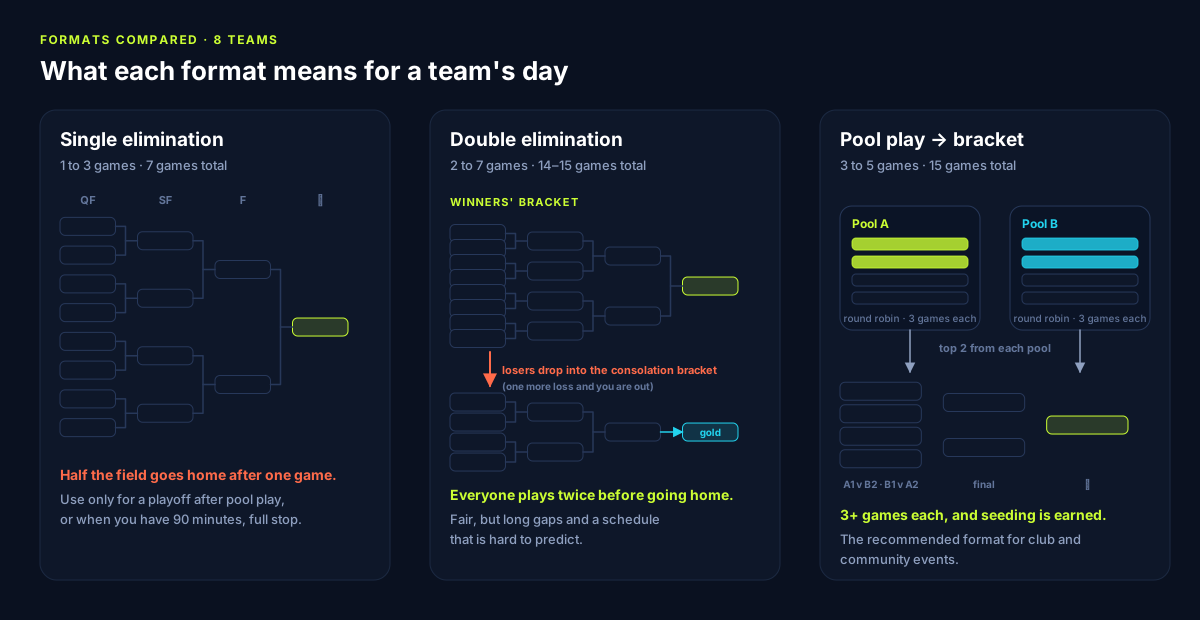
For a 16-team division on 4 courts, with games to 11 taking about 18 minutes including changeover:
| Format | Games per team | Total games | Court time on 4 courts | Good for |
|---|---|---|---|---|
| Single elimination | 1–4 | 15 | ~1 h 30 min | Very short time slots; a playoff after pools |
| Single elimination + first-round consolation | 2–4 | 22 | ~2 h | A quick event where everyone plays twice |
| Double elimination | 2–9 | 30–31 | ~4 h with single games to 11; most of a day as best of 3 | Competitive divisions; what most sanctioned events use |
| Round robin | 15 | 120 | ~9 hours | Only for divisions of 4–7 teams |
| Pool play → bracket (pools of 4, top 2) | 3–6 | 24 + 7 | ~2 h 45 min | Almost everything else |
Single elimination
Lose once and you are out. Fastest format, least satisfying: half the field plays one game, and the draw decides more than the play. Use it only as the playoff after pool play, or when you have 90 minutes and no choice. Seed it so 1 plays the lowest seed, and give byes to the top seeds.
Double elimination
Every team has to lose twice. Losers from the winners' bracket drop into a consolation ("opportunity") bracket and keep playing until they lose again.
The consolation winner meets the winners' bracket champion for gold. Because the winners' bracket team has not yet lost, the consolation team has to beat them twice: the first match in the event's normal format, then — as rule 15.B.1 requires — a tie-breaker match to 15 points. The same rule gives bronze to the loser of the consolation final.
It is the format most sanctioned events use, and the fairest elimination format. Two costs: the schedule is hard to predict, because the consolation side runs more rounds than the winners' side, and a team that loses early can spend the day waiting between consolation games. For 8 teams expect 14 or 15 games; for 16, 30 or 31.
Round robin
Every team plays every other team once. Perfect for 4 to 7 teams — the whole division is one pool — and unusable above that. Seven teams is 21 games; eight is 28. With 6 or more teams, one game to 11 per match keeps it moving. Publish a tiebreaker order in advance; see tiebreakers and scoring formats.
Pool play into a bracket
Divide the division into pools of 4 (or 5), play a round robin in each, and send the top two from each pool into a single-elimination bracket. Every team gets three games minimum, the bracket is seeded by results, and the day is predictable.
It is the format we recommend for almost every club and community event. How to set up pool play covers pool sizes, seeding and the crossover playoff in detail.
Team events
Clubs sometimes enter teams of 4 to 8 players and play a fixed set of matches per tie — two men's doubles, two women's doubles and two mixed, say — with the tie going to the side that wins more matches. It is an inter-club format more than a tournament format, and a lot of scheduling. Keep it for a two-club challenge day.
Size the divisions
A division is one bracket: a skill level, an age group, and a gender category. The classic grid is skill (2.5, 3.0, 3.5, 4.0, 4.5, 5.0) × gender (men's, women's, mixed), sometimes × age — USA Pickleball's current sanctioned brackets are 19+, 30+, 40+ and 50+, with 50+ optionally rising in five- or ten-year steps. Every cell you open needs enough teams to be worth a bracket.
- Minimum viable division: 4 teams. Below that, combine — 3.0 and 3.5 women's into one bracket, or 50+ into 19+. Tell the affected players before the day, not at check-in.
- Sweet spot: 8 to 16 teams. Two to four pools of 4, an 8-team playoff, everything finishes inside a half-day wave.
- Maximum for one wave: about 24 teams on 6 courts. Above that, split the division into two waves or two days.
- Guarantee at least two matches per entrant. USA Pickleball requires it of sanctioned events — rule 15.F, "a minimum of two scheduled matches per event entered" — with one exception, single elimination without consolation. Paying players expect it everywhere.
Skill levels are self-declared unless you use ratings. A DUPR-based entry requirement removes most sandbagging arguments and gives you an objective way to seed. Two band conventions are in circulation: DUPR's own brackets run on floors (3.500–3.999 is the 3.5 bracket), while some events centre the band on the division number (3.25–3.74). Either works — pick one, write it numerically on the entry form, and keep the band about half a point wide. DUPR itself runs from 2.000 to 8.000, and new players start unrated.
Do the court and time math
This is where tournaments are won or lost, weeks before the day.
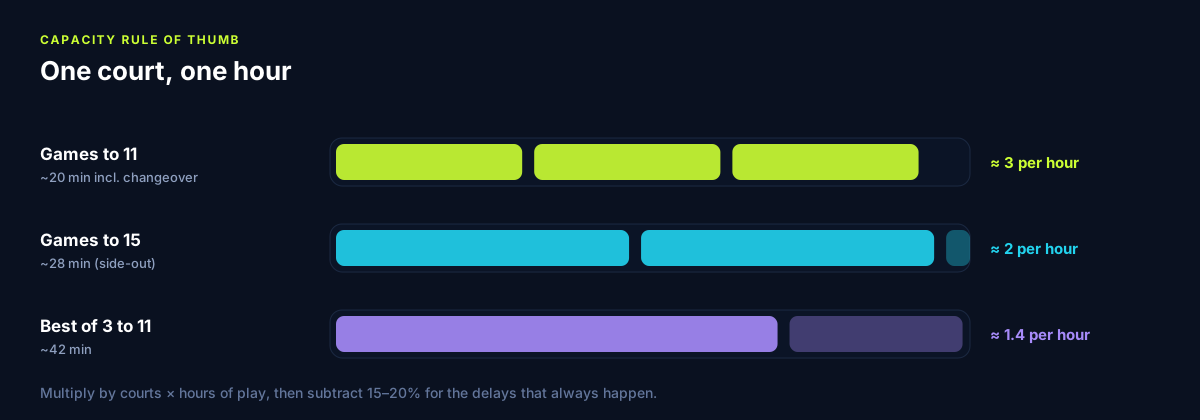
| Courts | Hours of play | Games to 11 (after 15–20% slack) | Best of 3 to 11 (after slack) |
|---|---|---|---|
| 4 | 4 | ~40 | ~19 |
| 4 | 8 | ~80 | ~38 |
| 6 | 8 | ~120 | ~57 |
| 8 | 8 | ~160 | ~76 |
| 12 | 8 | ~240 | ~115 |
Then count the games each division needs. Pools of 4 with a top-2 bracket: 6 games per pool + (qualifiers − 1) bracket games. A 16-team division is 24 pool games plus 7 bracket games — 31 games, roughly a 3-hour wave on 4 courts with slack.
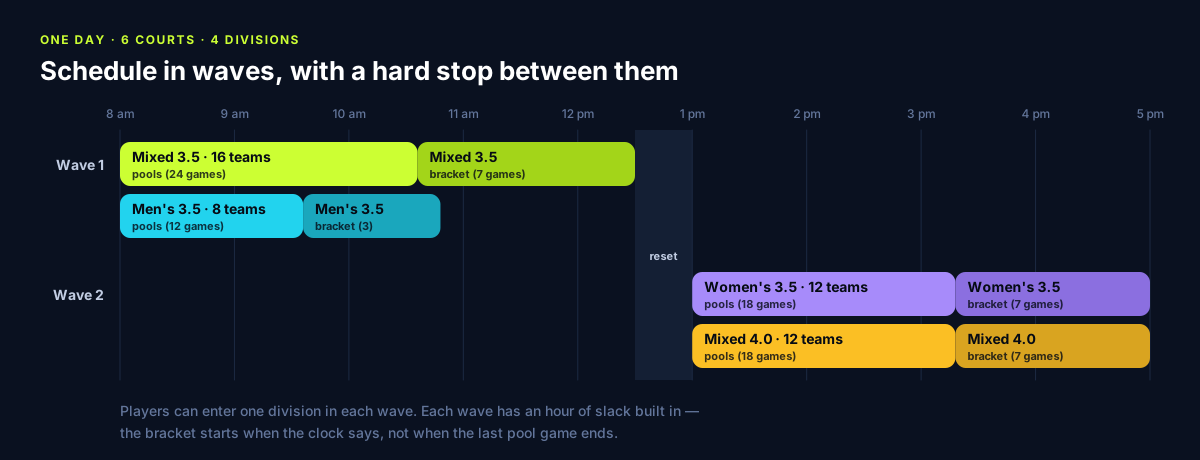
Build the schedule as waves: divisions that start together and finish together, sharing the courts. Players can enter one division in each wave; nobody can sensibly enter two divisions in the same wave. Post the wave times with registration so entrants can plan.
Registration, fees and communication
Open registration 6 to 8 weeks out and close it 7 to 10 days before the event. You need final numbers to build divisions, and late additions are what break seeding.
Collect:
- Both players' names, contact details and skill rating (self-rated, or DUPR ID)
- Division(s) entered, with wave times visible so nobody double-books
- Payment, a waiver, and an emergency contact
- A "partner needed" flag if you are willing to match singles into pairs
Fees at community events commonly run $35 to $75 per player per event, and $50 to $100+ for sanctioned events; a second division is usually discounted. Say what the fee covers (courts, balls, medals, lunch) and what the refund policy is — typically a full refund until registration closes and none after, because the bracket is built.
Expect withdrawals and no-shows — Pickleball.com's organizer guide puts the typical rate at 5–10%, and free or low-cost events run higher. Keep a waitlist per division and fill from it up to the day before.
Communication that prevents day-of problems:
- A confirmation email with division, wave time and check-in time
- The schedule and pools published 3 to 5 days before
- A reminder the night before: parking, what to bring, the rules summary
- A group chat or live results page on the day, so players are not crowding the desk to ask when they play
Seed the brackets and pools
Seeding decides who meets whom and when. Rank every team in a division by combined rating, then:
- For pool play, snake the ranked list into pools (1, 2, 3, 4 across the pools, then 8, 7, 6, 5 back) so every pool has a team from each strength band.
- For an elimination bracket, seed 1 at the top, seed 2 at the bottom, seeds 3 and 4 in the other quarters. The standard 8-team first round is 1 v 8, 4 v 5, 3 v 6, 2 v 7.
- Byes go to the highest seeds when the entry is not a power of two. Seven teams in an 8-bracket: seed 1 sits out the first round.
- Keep clubmates and family apart in the first round where you can without breaking the seeding bands.
Without ratings, seed on last year's results and what you know, and accept that the pool stage will correct you — the best argument for pool play over a straight bracket.
Set the scoring rules and publish them
Write a one-page rules sheet and post it with the schedule. Decide:
- Match format by stage. The rulebook's four standard scoring options (rule 15.C.1) are best two-of-three games to 11; best three-of-five to 11; one game to 15 or 21; and — for round robin events of six or more teams only — one game to 11. All are win by 2, with win by 1 allowed for team play. The 2026 rulebook no longer singles one out as "recommended," but best two-of-three to 11 is still the usual choice for medal rounds. A common time-saver: one game to 11 (or 15) in pools, best of three in the bracket, always best of three in the final.
- Side-out or rally scoring. Traditional side-out scoring is still the default. Rally scoring has been a provisional option for tournament directors since 2025 (rules 14.A and 15.C.2; excluded from double-elimination doubles, Golden Ticket events and Nationals), and it makes game length far more predictable. New for 2026: the old "freeze" is gone, so either side can win the game on any rally. If you use it, say so on the rules sheet.
- Tiebreakers for pools: head-to-head, then point differential across all games, then head-to-head differential, then differential against the next-highest team, then total points scored — the USA Pickleball order (rule 15.B.4). Differential comparisons do not carry across pools of unequal size.
- Time limits. If courts close at a fixed time, say what happens to unfinished games: first to 11 win by 1, or the team ahead when the horn goes.
- Forfeits and late arrivals. A stated grace period (five or ten minutes after the match is called), then a forfeit recorded as 11–0 so the tiebreak math still works.
- Line calls and disputes. Players call their own lines; a replay on any honest disagreement; the director's decision is final. Referees for the final if you have them.
Staff the day
A tournament needs one person who is not playing. For events up to about 32 teams:
| Role | What they do | How many |
|---|---|---|
| Tournament director | Owns the schedule, rulings, withdrawals and the clock. Does not play. | 1 |
| Desk | Check-in, collects scores, posts standings, calls the next matches | 1–2 |
| Court monitors | One per 2–3 courts: confirms the right teams are on, collects score sheets, chases stragglers | 2–4 |
| Referees (optional) | Medal matches, or every match at a sanctioned event | 0–4 |
| Floaters | Balls, water, first aid, photos, food | 1–2 |
Brief the volunteers 45 minutes before check-in opens. Give the desk a printed schedule and blank score sheets, the monitors a group chat, and everyone the rules sheet.
On the day, the director's job reduces to one thing: keep courts full. The moment a court empties, the next match should already have been called. A visible "now playing / on deck" board — a whiteboard, a TV, or a live results page on players' phones — is the single biggest time-saver you can add.
Budget
| Item | Notes |
|---|---|
| Courts | Free at many public parks; indoor facilities charge by the court-hour |
| Balls | 1–2 new balls per court per division, plus spares; an approved ball if sanctioned |
| Medals or prizes | Medals for the top three per division is the norm; gift cards for a club night |
| Sanctioning fee and insurance | Only if sanctioning; check current USA Pickleball fees |
| Referees | Certified referees are commonly paid a day rate; volunteers for club events |
| Printing | Schedules, pool sheets, score sheets, rules, signage |
| Food and water | Water is mandatory; lunch optional and often a fundraiser |
| Software | Registration and payment fees; bracket software (free options exist) |
| T-shirts, photographer, banners | Optional; sponsors often cover them |
Price the entry so the event breaks even at 75% of the entries you hope for.
The planning timeline
| When | What |
|---|---|
| 10–12 weeks out | Date, venue and courts confirmed. Divisions drafted. Sanctioning application submitted if applicable. |
| 8 weeks out | Registration open with fees, waiver, divisions and wave times. Volunteers recruited. Sponsors approached. |
| 4 weeks out | Push registration. Order balls, medals, printing. Confirm referees. |
| 2 weeks out | Review entries per division; plan merges. Confirm venue hours and net setup. |
| 7–10 days out | Registration closes. Final divisions set; waitlist filled. Seeding done. |
| 3–5 days out | Schedule, pools and brackets published. Confirmation email sent. |
| Day before | Courts checked, nets at 34 inches at the centre and 36 at the sidelines, desk set up, score sheets printed, balls opened. Reminder sent. |
| Day of | Staff 45 minutes before check-in. Check-in 30–45 minutes before the first match. Keep courts full. |
| Within 48 hours | Results published, ratings reported, survey sent, volunteers thanked. |
Day-of checklist
Before check-in opens
- Nets at regulation height; court numbers visible from the desk
- Schedule, pools, brackets and rules posted — wall, fence and online
- Desk set up: check-in list, score sheets, pens, tape, a clock everyone can see
- Balls opened, first-aid kit out, water stations filled
- Volunteers briefed and assigned
During play
- Call matches 2 minutes before a court frees; keep an on-deck list
- Collect every score before the teams leave the court area
- Post standings at the end of each pool round
- Track withdrawals; apply the forfeit rule the same way every time
- Watch the clock against the plan; cap games if a wave runs 20 minutes late
After the final
- Medals and a photo for each division, announced by name
- Results posted online the same day
- Balls, nets, tables, trash — leave the venue as you found it
- Notes while it is fresh: what ran late, what ran out, what to change
Common mistakes
- Too many teams for the courts. Use the capacity table — its numbers already include 15–20% slack, so do not count on the slack twice.
- A format with no guaranteed games. Single elimination for a paying field is how you lose half your entrants next year.
- Divisions of 2 or 3 teams. Merge early and tell people.
- Unpublished tiebreakers. Every three-way tie becomes an argument.
- Starting late. A 9:00 start that begins at 9:25 ends at 5:25. Call the first matches at 8:55.
- The director playing. Somebody must be free to make decisions at 2 pm.
- No on-deck board. "When do I play?" becomes the desk's entire day.
- No weather plan. Outdoor events need a rain date or an indoor fallback, and a shortened format (games to 7 or timed rounds) ready for a late restart.
Frequently asked questions
How many courts do you need for a pickleball tournament?
A court handles about three games to 11 per hour. Count the games each division needs (pools of 4 with a top-2 playoff: 6 games per pool plus 7 for an 8-team bracket), divide by 3 for court-hours, then divide by the hours you have. A 16-team division is about 31 games — roughly 3 hours on 4 courts with slack. Four courts run a 16–24 team day comfortably; 8–12 courts run a multi-division weekend.
What is the best format for a pickleball tournament?
Pool play into a single-elimination bracket. Every team gets at least three games, the bracket is seeded by results, and the schedule is predictable. Double elimination is what most sanctioned events use and is fair, but harder to schedule; single elimination alone is only for a playoff or a very short time slot.
How does double elimination work in pickleball?
Teams play in a winners' bracket until they lose, then drop into a consolation bracket where a second loss eliminates them. The consolation winner plays the winners' bracket champion for gold and must beat them twice, because that team has not yet lost. The first match uses whatever format the event adopted (commonly best of three to 11); if the consolation team wins it, rule 15.B.1 requires a tie-breaker match to 15 points to decide gold and silver. The same rule fixes bronze: the loser of the consolation final takes third.
How long does a pickleball tournament take?
A single 16-team division on 4 courts is about 2 hours 20 minutes of raw play, or 3 hours once the usual slack is included. A three- or four-division club event fills a day on 6 courts in two waves. Multi-division sanctioned events run two or three days. Build the schedule in waves with a hard stop between them.
How far in advance should you plan a pickleball tournament?
Eight to twelve weeks for a local club or community event; four to six months for a regional or sanctioned event. Registration should open 6–8 weeks out and close 7–10 days before the day so divisions and seeding can be finalized.
Do I need USA Pickleball sanctioning?
Only if your players want official ranking points and rating updates through sanctioned play. Sanctioning requires an application at least 30 days before registration opens, a USA Pickleball Champion or Challenger membership for every player, an approved ball, a refereeing tier (Standard, Medal Match Plus or No-Referee) and adherence to the official rulebook. Most club and charity events are unsanctioned and can still submit results to DUPR, which is USA Pickleball's official rating system.
What happens if a team does not show up?
Apply a stated grace period after the match is called, then record a forfeit (11–0 or 15–0) so tiebreakers still compute, and fill the slot from the waitlist if it is before the first game. In pool play, USA Pickleball goes further (rule 15.B.4.a): a withdrawn team's results are struck from the standings and the team is ineligible for the playoff. Pick one approach and publish it.
Keep reading
- Pool playHow to Set Up Pickleball Pool Play (Pool Sizes, Seeding, Tiebreakers and the Playoff)How to run pickleball pool play that finishes on time — choosing pool sizes, snake-seeding by rating, scheduling the round robin inside each pool, breaking ties the USA Pickleball way, and crossing the top finishers into a playoff bracket. Covers fixed-partner pools and rotating-partner pools with an individual table.
- Charity eventsHow to Run a Charity Pickleball Tournament That Actually Raises MoneyThe fundraiser-specific playbook for a charity pickleball tournament — where the money really comes from (sponsorships beat entries), how to price entries and build sponsor tiers, a format that keeps a mixed-ability field happy, raffle and games ideas with the legal cautions, a realistic budget, and the day-of details that make people come back next year.
- PrintablesFree Pickleball Printables: Score Sheets, Pool Sheets, Brackets, Sign-In Sheet and Rotation PosterNine free, print-ready PDFs for pickleball organizers — a round robin score sheet, pool play sheets for pools of 4 and 5, single-elimination brackets for 4, 8 and 16 teams, a player sign-in sheet, an open play rotation poster and a fill-in rules one-pager — plus how to use each one so the paper runs the event for you.
- Rules & scoringPickleball Tiebreakers and Scoring Formats Explained (Head-to-Head, Point Differential, Rally Scoring, Caps and Skinny Singles)How to score a pickleball event and settle the standings — side-out vs rally scoring, games to 11, 15 or 21, win-by-2 caps, timed rounds and best-of-three; then the USA Pickleball tiebreaker order (head-to-head, point differential, head-to-head differential) with worked two-way and three-way examples, individual standings for rotating-partner events, and when to use a skinny singles play-off.