Pool play
How to Set Up Pickleball Pool Play (Pool Sizes, Seeding, Tiebreakers and the Playoff)
How to run pickleball pool play that finishes on time — choosing pool sizes, snake-seeding by rating, scheduling the round robin inside each pool, breaking ties the USA Pickleball way, and crossing the top finishers into a playoff bracket. Covers fixed-partner pools and rotating-partner pools with an individual table.
Updated 13 min readBy the PicklePal team
On this page
- When pool play beats a round robin or a straight bracket
- The pool play formats
- Step 1: Choose pool sizes
- Step 2: Seed the pools
- Step 3: Schedule the pool games
- Step 4: Pool standings and tiebreakers
- Step 5: Cross the pools into the playoff
- A full timeline: 16 teams, 4 courts, one afternoon
- Worked examples
- Day-of checklist
- Common mistakes
- Frequently asked questions
Pool play is what tournament directors reach for when they want two things at once: everyone gets a proper number of games, and the day ends with a champion.
A straight single-elimination bracket sends half the field home after one game. A full round robin of 16 teams is 120 games. Pool play gives every team three or four games, earns the bracket seeding on court, and still finishes with a final. It is also the best format for a club night with a finish: twelve players, two pools, a playoff, done in two hours with a winner and a photo.
This guide covers both versions you will meet. In fixed-partner pools teams stay together and the pool ranks teams. In rotating-partner pools everyone plays with everyone in their pool and the pool ranks individuals. The math is the same; the playoff is built differently.
When pool play beats a round robin or a straight bracket
| Format | Games per team | Court time, 16 teams on 4 courts | Finishes with | Weak spot |
|---|---|---|---|---|
| Single elimination | 1 to 4 | ~1 h 30 min | A champion | Half the field plays once |
| Double elimination | 2 to 9 | ~4 hours | A champion | Long waits; hard to schedule |
| Full round robin | 15 | ~9 hours | Standings only | Far too long above 8 teams |
| Pool play + playoff | 3 to 6 | ~2 h 45 min | A champion and full rankings | Badly seeded pools |
Choose pool play when you have 8 or more teams, when players have paid or travelled and deserve more than one game, or when you want the bracket seeded by results rather than guesses.
Choose a plain round robin for 4 to 7 teams — the "pool" is the whole field anyway. Choose a bracket alone only when time is very short. The elimination formats are unpacked in how to run a pickleball tournament.
The pool play formats
Fixed-partner pools
Teams enter as pairs. Each pool runs a round robin: a pool of four plays 6 games (3 per team), a pool of five plays 10 (4 per team), a pool of six plays 15 (5 per team). Standings rank teams; the top teams cross into a bracket.
This is the format used by sanctioned tournaments and most club championships. Teams know their partner, the bracket is easy to read, and the final is a real doubles final.
Rotating-partner pools (individual standings)
Players enter as individuals. Inside each pool, partners rotate every game so each player partners everyone in the pool, and the table ranks individuals — everyone for themselves. This is the social-night version of pool play: no one needs a partner, and the pool stage feels like a normal mixer.
The catch is the playoff. Individuals cannot play a doubles bracket, so the playoff has to build teams from the pool results. The fair way is to partner the same finishing position from each pool: the two #1s form a team, the two #2s form a team, and so on. More on that below.
Because the table ranks individuals, two players can finish with identical records and identical point differential. That is what skinny singles tiebreakers are for.
Flighted pools
If the field spans a wide skill range, seed the pools by level instead of evenly: a 3.0 pool, a 3.5 pool, a 4.0 pool. Each pool runs its own playoff or simply finishes with its own standings. This is really three small events sharing courts, and it is the right answer when a 3.0 playing a 4.5 would be no fun for either.
Step 1: Choose pool sizes
The pool size decides how many games everyone gets and how long the day is. Work backwards from your time.
| Pool size | Games in the pool | Games per team | Rounds | Time at ~18 min per game |
|---|---|---|---|---|
| 3 teams | 3 | 2 | 3 (one sits each round) | ~55 min on 1 court |
| 4 teams | 6 | 3 | 3 | ~55 min on 2 courts |
| 5 teams | 10 | 4 | 5 | ~90 min on 2 courts |
| 6 teams | 15 | 5 | 5 | ~90 min on 3 courts |
| 7 teams | 21 | 6 | 7 | ~2 h 05 min on 3 courts |
| 8 teams | 28 | 7 | 7 | ~2 h 05 min on 4 courts |
Rules of thumb:
- Pools of 4 are the default for a one-day event: three guaranteed games, three rounds, and a pool of 4 fits neatly on two courts.
- Pools of 5 or 6 when you want more games and have the time. Six is the practical ceiling.
- Avoid pools of 3. Two games is a thin day for a team that drove an hour, and one result decides who advances.
- Keep pool sizes equal. If 14 teams give you pools of 4, 4, 3 and 3, either rank by win percentage, go to two pools of 7, or recruit two more teams.
How many pools?
Pools = teams ÷ pool size. Sixteen teams is four pools of 4; twelve is three pools of 4 or two pools of 6; twenty is five pools of 4.
The number of pools also sets the playoff size. Four pools with the top 2 advancing makes an 8-team bracket (quarter-finals). Two pools with the top 2 makes a 4-team bracket (semi-finals).
Courts and time
Pool time ≈ (total pool games ÷ courts) × minutes per game
Sixteen teams in four pools of 4 is 24 pool games. On 4 courts at 18 minutes that is 6 time slots — about 1 hour 50 minutes. On 8 courts it is 3 slots, under an hour. An 8-team playoff adds three rounds (quarters, semis, final), roughly another hour.
Step 2: Seed the pools
Random pools produce a "pool of death" and a pool that is a walkover. Seeding fixes this.
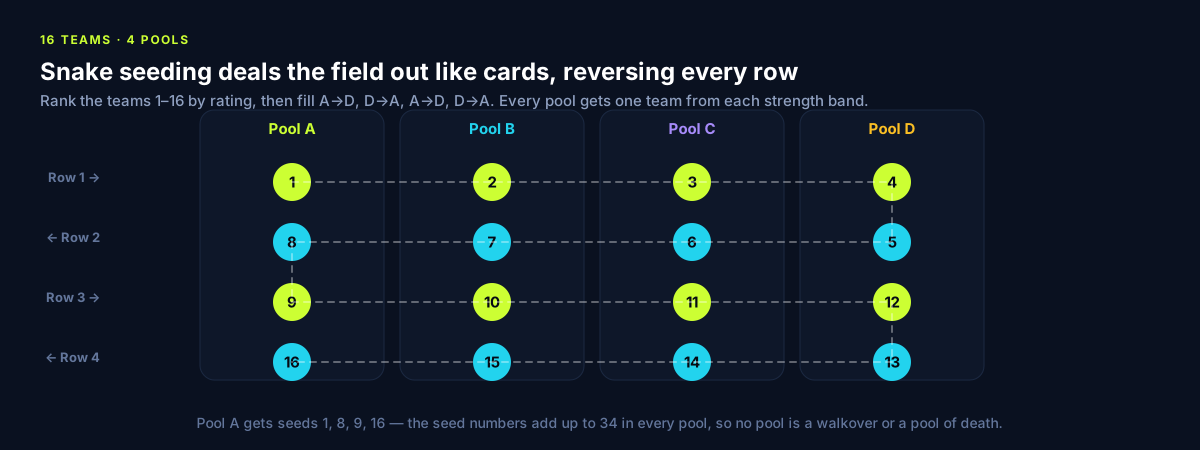
Snake seeding is the standard method. Rank every team from strongest to weakest — combined DUPR is the usual yardstick; last year's results or your own judgement when there are no ratings. Then deal them out like cards, reversing direction every row.
Two adjustments worth making by hand afterwards:
- Keep two teams from the same club or family apart when you can. They would rather meet in the bracket than in the pool.
- Put any team that asked for a late start in a pool whose schedule can absorb it.
For rotating-partner pools, seed individual players the same way. Balanced pools matter even more here, because the playoff partnering rewards pool position.
Step 3: Schedule the pool games
Inside each pool, use the circle method so every team plays every other team exactly once. For a pool of 4:
| Round | Game 1 | Game 2 |
|---|---|---|
| 1 | 1 vs 4 | 2 vs 3 |
| 2 | 1 vs 3 | 2 vs 4 |
| 3 | 1 vs 2 | 3 vs 4 |
The 1-vs-2 game — the probable top-two decider — comes last on purpose. It keeps both teams interested all the way through.
For a pool of 5, five rounds with one team sitting each round:
| Round | Game 1 | Game 2 | Sitting |
|---|---|---|---|
| 1 | 1 vs 4 | 2 vs 3 | 5 |
| 2 | 1 vs 5 | 2 vs 4 | 3 |
| 3 | 1 vs 3 | 4 vs 5 | 2 |
| 4 | 2 vs 5 | 3 vs 4 | 1 |
| 5 | 1 vs 2 | 3 vs 5 | 4 |
Practical rules:
- One pool per pair of courts. Pool A lives on courts 1–2, Pool B on 3–4. Players always know where to go.
- Run rounds in lockstep so the playoff can start at a known time. If one pool is stuck in a 15–13 marathon, let the others start their next round.
- Give rest where you can. In a pool of 5 the sit-out does it; in a pool of 4 on two courts, keep games to 11 or allow two minutes between rounds.
- Print the pool sheets with blank score boxes, or let players enter scores on their phones.
Step 4: Pool standings and tiebreakers
Rank by wins first. Then break ties in the order USA Pickleball uses for round robin brackets (2026 rulebook, rule 15.B.4):
- Head-to-head matches won between the tied teams
- Point differential across all pool games
- Head-to-head point differential
- Point differential against the next-highest-placed team
- Total points scored across all matches
Two caveats matter for pool play specifically. Steps 2 and 5 do not apply across pools of unequal size, so if you ended up with pools of 4 and 5 you cannot compare differentials between them — decide in advance how you will rank across uneven pools (win percentage is the usual answer). And a team that withdraws or is forfeited has its results struck from the standings entirely under rule 15.B.4.a, not merely excluded from the tiebreak.
A two-way tie is almost always settled by head-to-head. A three-way tie where each team beat one of the others skips head-to-head, because it is circular, and goes to point differential. Write the order on the rules sheet so nobody discovers it at 3 pm. The worked three-way example is in pickleball tiebreakers and scoring formats.
For rotating-partner pools rank individuals by wins, then point differential, then points scored — head-to-head is murky when two players may have met as partners as well as opponents. When two players are still dead level after all that, play it off. A skinny singles game to 7 on half a court takes five minutes and settles the seeding on court rather than by coin flip.
Step 5: Cross the pools into the playoff
How many advance?
| Pools | Advancing per pool | Bracket | Playoff rounds |
|---|---|---|---|
| 2 | Top 2 | 4-team (semis + final) | 2 |
| 2 | Top 4 | 8-team (quarters) | 3 |
| 3 | Top 2 + 2 best 3rd-placed | 8-team | 3 |
| 4 | Top 1 | 4-team | 2 |
| 4 | Top 2 | 8-team | 3 |
| 4 | Top 4 | 16-team | 4 |
Top 2 from every pool is the usual choice: half the field makes the bracket, so the pool stage means something for everyone, and the bracket is short. If your pool count does not produce a power of two, either give the best pool winners byes or take the best third-placed teams (ranked by wins, then point differential) to fill the bracket.
Crossover seeding
The convention that keeps the playoff fair is A1 vs B2, B1 vs A2. Pool winners are rewarded with a runner-up, and two teams from the same pool cannot meet before the final.
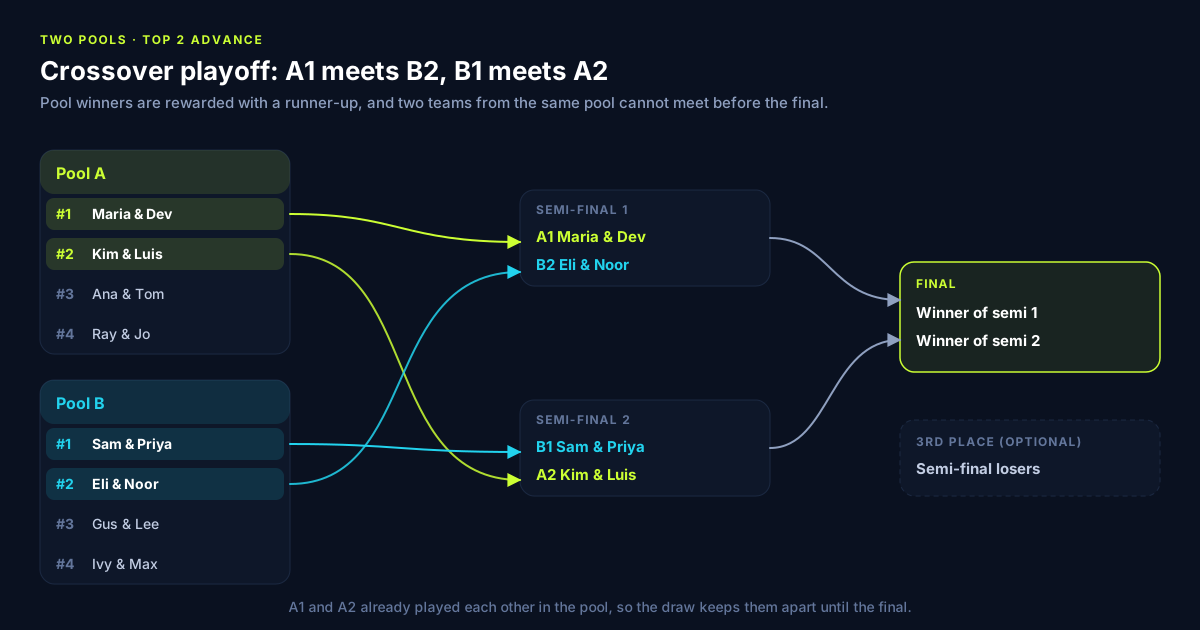
The alternative is to rank all qualifiers — every pool winner by record, then every runner-up — and seed 1 vs 8, 2 vs 7 and so on. It gives the strongest pool winner the easiest draw but can set up a same-pool rematch in the first round. Use it when pools were uneven in size and "pool winner" means different things in different pools. It is also what most bracket software does by default, PicklePal included — so check the draw before you post it, and swap two names if a first-round rematch appears.
Rotating partners: forming the playoff teams
Partner the same finishing position from each pool, then seed the teams by that position.
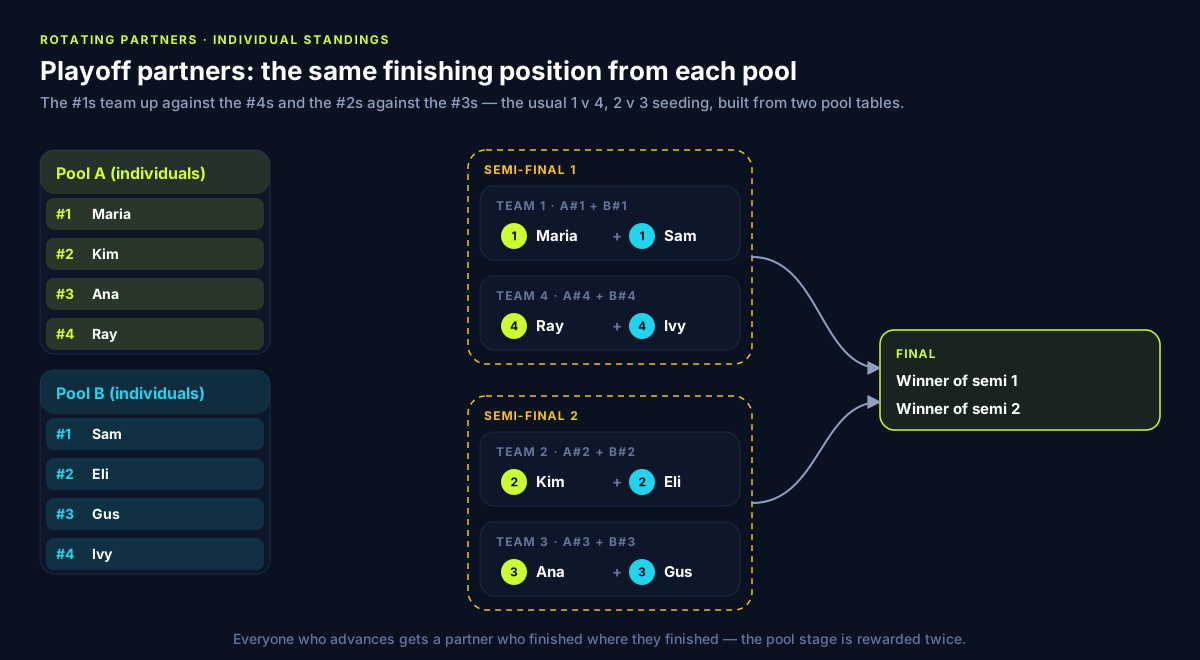
Everyone who advances gets a partner who finished where they finished, which rewards the pool stage and balances the bracket. This pairing assumes exactly two pools — with three pools you would be building triples — so with more than two rotating pools, run a bracket per pair of pools or switch to fixed partners for the playoff.
Bracket mechanics
- Byes go to the top seeds when the bracket is not full. An 8-team bracket with 6 qualifiers gives seeds 1 and 2 a free quarter-final.
- 3rd-place game between the semi-final losers if you are awarding bronze. Skip it for a club night.
- Format: pool games to 11 and bracket games best two-of-three to 11 is a common split. Games to 15 for the final only is a fine compromise when time is tight.
A full timeline: 16 teams, 4 courts, one afternoon
| Time | What is happening |
|---|---|
| 12:30 | Check-in. Pools and court assignments posted on the wall and in the group chat. |
| 1:00 | Pool round 1 for Pools A and B on courts 1–4. |
| 1:20 | Pool round 1 for C and D. Then alternate A/B and C/D rounds. |
| 3:00 | Pool stage done (24 games in 6 slots). Standings posted; tiebreakers applied; quarter-finals announced by 3:10. |
| 3:15 | Quarter-finals on all four courts. |
| 3:45 | Semi-finals on two courts; a consolation game for quarter-final losers on the other two. |
| 4:15 | Final (best of three to 11) and 3rd-place game. |
| 5:00 | Medals, photo, done. |
Every team plays at least three games; the champion plays six matches. About four and a half hours including check-in — the realistic length of a 16-team day on four courts.
Worked examples
Day-of checklist
- Pools, seedings and the tiebreaker order printed and posted before the first game.
- Courts numbered to match the schedule.
- One score sheet per pool, with a person responsible for collecting it.
- Scoring rules announced: points, win-by, caps, rally or side-out, and whether pool and bracket games differ.
- Withdrawal policy: remaining games forfeited 0–11, or — the USA Pickleball approach (rule 15.B.4.a) — the team's results struck from the standings entirely and the team ineligible for the playoff. Pick one and publish it.
- A playoff start time that you announce during the pool stage and keep.
- Balls, a whistle or air horn, a first-aid kit and a spare paddle.
Common mistakes
- Pools of unequal strength. Seed them. A pool of death sends a good team home after three games while a weak pool's winner walks into the semis.
- Starting the bracket late. Announce the playoff start time and hold to it, even if it means capping the last pool game.
- Forgetting the rematch rule. Crossover seeding (A1 vs B2) exists so the first playoff game is not a repeat of a pool game.
- Breaking ties by total points. Use wins, then head-to-head, then point differential — and say so in advance.
- Advancing too many. If everyone advances, the pool stage is a warm-up. Top 2 per pool keeps it honest.
- Skinny singles play-offs in fixed-partner pools. Fixed teams almost never need them; head-to-head and point differential settle a team tie in all but the rarest case.
Frequently asked questions
What is pool play in pickleball?
Pool play divides the entrants into small groups of 4 to 6 teams (3 only if the numbers force it). Each group plays a round robin, so every team plays every other team in its pool, and the top finishers from each pool advance to an elimination bracket. It guarantees every team several games and seeds the bracket by results.
How many teams should be in a pool?
Four is the standard: three games per team in three rounds, and a pool of four fits on two courts. Five or six give more games when you have the time; three is too few because a single result decides who advances.
How do you seed pickleball pools?
Rank every team by strength (combined DUPR, past results or the director's judgement) and snake them into the pools: seeds 1, 2, 3, 4 go to pools A, B, C, D, then seeds 5, 6, 7, 8 go to D, C, B, A, and so on. Every pool ends up with one team from each strength band.
How many teams advance from pool play?
Usually the top two from each pool. With four pools that makes an 8-team bracket (quarter-finals, semi-finals, final). With two pools it makes a 4-team bracket. Taking only pool winners halves the playoff; taking the top four doubles it.
What happens if two teams tie in pool play?
Head-to-head result first. If that does not settle it — a three-way tie, or a split in a double round robin — use point differential across all pool games, then head-to-head point differential, then point differential against the next-highest team, then total points scored. Point differential cannot be compared across pools of different sizes. In rotating-partner pools where individuals are ranked, an unresolved tie is played off with skinny singles.
Can you do pool play with rotating partners?
Yes. Inside each pool, partners rotate every game so the table ranks individuals. For the playoff, pair the same finishing position from each pool — the two #1s form a team, the two #2s form a team — then seed those teams 1 vs 4 and 2 vs 3. It needs exactly two pools so that every playoff team has two players.
How long does pool play take?
Estimate (total pool games ÷ courts) × minutes per game. Sixteen teams in pools of four is 24 games; on four courts at 18 minutes a game that is about 1 hour 50 minutes, plus roughly an hour for an 8-team playoff.
Keep reading
- TournamentHow to Run a Pickleball Tournament (Formats, Divisions, Court Math, Scheduling and a Day-Of Checklist)The organizer's guide to running a pickleball tournament, from an 8-team club championship to a sanctioned multi-division event — picking a format, sizing divisions, doing the court and time math, seeding brackets, setting scoring rules, staffing the day and avoiding the mistakes that put you two hours behind by lunch.
- Rules & scoringPickleball Tiebreakers and Scoring Formats Explained (Head-to-Head, Point Differential, Rally Scoring, Caps and Skinny Singles)How to score a pickleball event and settle the standings — side-out vs rally scoring, games to 11, 15 or 21, win-by-2 caps, timed rounds and best-of-three; then the USA Pickleball tiebreaker order (head-to-head, point differential, head-to-head differential) with worked two-way and three-way examples, individual standings for rotating-partner events, and when to use a skinny singles play-off.
- PrintablesFree Pickleball Printables: Score Sheets, Pool Sheets, Brackets, Sign-In Sheet and Rotation PosterNine free, print-ready PDFs for pickleball organizers — a round robin score sheet, pool play sheets for pools of 4 and 5, single-elimination brackets for 4, 8 and 16 teams, a player sign-in sheet, an open play rotation poster and a fill-in rules one-pager — plus how to use each one so the paper runs the event for you.
- ChartsPickleball Round Robin Charts for 4 to 16 Players (Printable Rotation Schedules)Ready-to-print pickleball round robin rotation charts for 4, 5, 6, 7, 8, 9, 10, 11, 12, 13, 14, 15 and 16 players on 1 to 4 courts. Every chart gives everyone the same number of games, rotates sit-outs fairly and keeps partner repeats to the minimum — with the exact fairness stats for each one.